

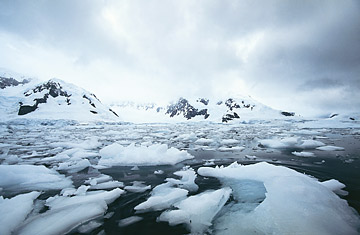
Ice floating in Paradise Bay, Antarctic Peninsula
(9 of 10)
The Antarctic Treaty nations may discuss tourism when they meet later this year, but they are more likely to be preoccupied with the growing debate over the future of oil and mineral development. Concern first arose after the 1973 oil crisis, when it became clear that there might someday be pressure to drill for petroleum, even in the harsh Antarctic environment. Eventually, the treaty nations decided it was best to have rules in effect before that happened. The result was the Wellington Convention, agreed to by representatives of 20 treaty nations in New Zealand's capital in June 1988. The document essentially forbids any mineral exploration or development without agreement by all treaty participants. But most environmentalists are disturbed by any accord that recognizes even the possibility of oil drilling. Naturalist Jacques-Yves Cousteau has called the Wellington Convention "nothing more than a holdup on a planetary scale."
There is no certainty that commercially valuable deposits of minerals exist. Surface rocks contain traces of iron, titanium, low-grade gold, tin, molybdenum, coal, copper and zinc. Gaseous hydrocarbons, sometimes associated with oil, have been found in bottom samples taken from the Ross Sea. But in most cases, says geologist Robert Rutford, president of the University of Texas at Dallas, who did research in Antarctica for more than 20 years, "minerals are less than 1% of the total rock sample analyzed." Moreover, the vicious Antarctic climate would make exploration dangerous and expensive.
Still, say the Wellington Convention's opponents, some countries might be tempted anyway. Contends Barnes of the Antarctic and Southern Ocean Coalition: "Some nations are awash in cash and technology and have no domestic oil supply. I think Japan would be down there as soon as the continent was opened up." Opponents of drilling point out that the Antarctic Treaty has not always been scrupulously adhered to, especially when it comes to fishing limits and environmental protection. They argue that the Wellington Convention could also be skirted.
Such arguments are behind the surge in support for a world park. The proposal by Australia and France last October that the continent be declared a "wilderness reserve" under the eye of an Antarctic environmental- protection agency -- essentially the world-park scheme by a different name -- was hailed by environmentalists as a big victory. The U.S., still officially committed to the Wellington agreement, did not go along with the new initiative. But some Administration officials are said to be opposed to the minerals convention, and Senator Gore claims he has the votes to prevent its ratification in the Senate. Observes Gore: "The whole theory of protecting Antarctica with mining that is carefully circumscribed by safety procedures is the approach that failed in Alaska's Prince William Sound. We shouldn't make the same mistake again."