

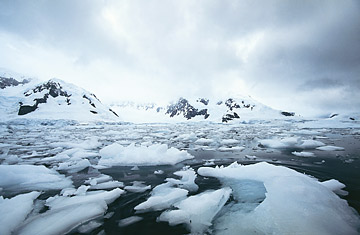
Ice floating in Paradise Bay, Antarctic Peninsula
(6 of 10)
Amid an atmosphere of international partnership, research has flourished. In the past few weeks alone, Antarctica's scientists have carried out dozens of unique experiments. In the McMurdo Sound area a group of geologists camped out in the bitter cold of the Royal Society mountains, looking for evidence of the ebbing and flowing of glaciers in Antarctica's past, and biologists drew 50-kg (110-lb.) fish from ice holes to study the unique organic antifreeze that keeps these sea dwellers alive. Volcanologists braved the knifelike winds and choking fumes atop Mount Erebus to learn what kinds of gases and particles Antarctica's largest volcano emits. At Williams Field, a runway on the Ross Ice Shelf, a multidisciplinary team prepared to launch a huge helium balloon. Its purpose: to follow circumpolar winds around the entire continent, gathering data on cosmic rays and solar flares and testing the behavior of high-density computer chips in the intense radiation of the upper atmosphere. And deep in the interior, glaciologists at the Soviets' Vostok Base dug out ice samples that carry clues to the planet's atmosphere in layers laid down in the polar ice cap tens of thousands of years ago.
At the South Pole, meanwhile, astrophysicists were taking advantage of a heat wave -- the temperature had soared to -23 degrees C (-10 degrees F) -- to set up detectors that would peer at the faint microwave radiation left over from the Big Bang explosion, which theoretically started the universe. In the high altitudes atop the pole's ice cap, the detectors are well above the densest, murkiest layers of atmosphere and can peer through some of the dryest, clearest air on earth to help determine whether the original Big Bang was unique or was followed by smaller ones. A few hundred yards away, close to the enormous geodesic dome that covers the thickly insulated buildings of the U.S.'s Amundsen-Scott South Pole Station, atmospheric scientists measured traces of pollutants released around the globe. The pole is so remote from civilization that there, better than anywhere else, scientists can accurately assess just how far-reaching are the effects of pollution.
The researchers who seek such knowledge are adventurous souls who know better than most the meaning of the term hardship post. Counting construction workers, maintenance crews and other support staff, Antarctica's population is only 4,000 or so, even in midsummer. The scientists and other residents tend to be in their 20s and 30s -- vigorous enough to endure the world's coldest workplace. A carpenter's helper recalls toiling one time at -40 degrees C (-40 degrees F) in an unheated building. She had on so many layers of clothing that it took most of her energy just to move, she says. As for the scientists, common sense sometimes gives way to a sense of mission. Researchers handling delicate experiments have been known to work without gloves in subfreezing temperatures until their hands were numb.