

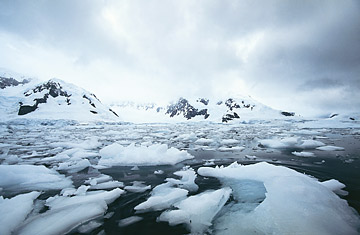
Ice floating in Paradise Bay, Antarctic Peninsula
(5 of 10)
The postwar German government did not press the Nazis' claim, but seven other nations with histories of Antarctic exploration -- Argentina, Chile, France, New Zealand, Britain, Norway and Australia -- maintained that parts of the continent belonged to them. Some of the claims overlapped: Chile, Britain and Argentina, for example, all declared their ownership of the Antarctic Peninsula. The U.S., while making no claims, refused to recognize those of other nations and organized numerous expeditions, including the largest in Antarctic history. Mounted in 1946 and called Operation Highjump, it was a naval exercise involving 13 ships, 50 helicopters and nearly 5,000 service members. Its unstated purpose: to make sure the U.S. could legitimately stake its own claim should it ever want to do so.
There could easily have been major territorial conflict, but scientific cooperation intervened. It took the form of the International Geophysical Year, actually 18 months long, which was scheduled to take advantage of the peak of sunspot activity predicted for 1957 and 1958. Sixty-seven countries joined in this exhaustive study of the interactions between the sun and earth. Much of the research went on in Antarctica, where Argentina, Australia, Belgium, Chile, France, Britain, Japan, New Zealand, Norway, South Africa, the U.S. and the Soviet Union established bases.
The Antarctic component of the IGY worked so well that after the project ended, President Dwight Eisenhower invited the eleven other nations that had built bases to join the U.S. in an agreement that would govern all activities on and around the frozen continent. The resulting Antarctic Treaty, ratified in 1961, forbids military activity, bans nuclear explosions and radioactive- waste disposal, and mandates international cooperation and freedom of scientific inquiry. Moreover, those participating countries that claimed chunks of Antarctica as their own agreed not to press those claims while the treaty remained in force. Over the years, 13 other countries have become voting members of the treaty system, and the original document has been supplemented by agreements governing topics as diverse as waste management and the protection of native mammals and birds.
The treaty did not eliminate the jockeying for position. The U.S. and the Soviet Union have deliberately placed bases in areas claimed by others, and countries have tried to solidify their stakes by setting up post offices and sending children to school in Antarctica. Argentina flew a pregnant woman to its Marambio base so that she could give birth to the first native of Antarctica. But no nation has overtly asserted sovereignty since the 1950s. Even during the Falklands war, Britain and Argentina, together with other nations, sat down to discuss Antarctic Treaty issues.