

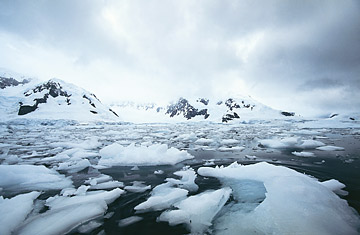
Ice floating in Paradise Bay, Antarctic Peninsula
(4 of 10)
Thus was created the world's largest stretch of inhospitable land. Precipitation is so sparse over Antarctica's 14 million sq. km (5.4 million sq. mi.) that it is classified as one of the world's dryest deserts. Because most of the small amount of snow never melts and has accumulated for centuries, 98% of Antarctica is permanently covered by a sheet of ice that has an average thickness of 2,155 meters (7,090 ft.). That accounts for 90% of the world's ice and 68% of its fresh water. Although the sun shines continuously in the summer months, the rays hit the land at too sharp an angle to melt the ice. At the South Pole, the average temperature is -49 degrees C (-56.2 degrees F) and the record high is -13.6 degrees C (7.5 degrees F). During the . perpetual darkness of winter, the temperature falls to almost inconceivable levels. The lowest ever recorded was in 1983 at the Soviet Union's Vostok Base: -89.2 degrees C (-128.6 degrees F).
Around the edges, though, Antarctica is more than just an icebox. On the Antarctic Peninsula, which reaches like a finger to within 965 km (600 miles) of South America, the temperature has risen as high as 15 degrees C (59 degrees F). The peninsula is home to the continent's only two species of flowering land plants, a grass and a pearlwort. Off the coast is one of the world's most productive marine ecosystems. Antarctica supports 35 species of penguins and other birds, six varieties of seals, twelve kinds of whale and nearly 200 types of fish.
It was the bountiful sea life that initially drew large numbers of men to the southern continent. When James Cook first circled Antarctica between 1772 and 1775, he saw hordes of seals on the surrounding islands, and during the next century the continent became a hunter's paradise. By the early 1900s, elephant and fur seals were nearly extinct. And after 1904, more than 1 million blue, minke and fin whales were harpooned in Antarctic waters.
Along with the exploiters came explorers, searching for nothing more than scientific knowledge and personal and national glory. In 1841 Britain's James Clark Ross became the first man to find his way through the sea ice and reach the mainland. The ultimate goal for the adventurers -- the South Pole -- was not reached until seven decades later, during the dramatic and ultimately tragic race between British explorer Scott and Norway's Roald Amundsen. Relying on dogsleds, which proved to be more dependable than the breakdown- prone mechanical sleds used by Scott, Amundsen's party arrived triumphantly at the pole on Dec. 14, 1911. When Scott got there a month later, he was devastated to find a Norwegian flag flying and notes from Amundsen. Things got even worse on the way back. Only 18 km (11 miles) from a supply depot, Scott and two companions were stopped by a blizzard, their fuel and food nearly gone. Scott's diary entries end this way: "We shall stick it out to the end, but we are getting weaker, of course, and the end cannot be far. It seems a pity, but I do not think I can write more . . . For God's sake look out for our people."
Airplanes made Antarctic travel much less perilous. In 1929 Richard Byrd, an American, became the first person to fly to the South Pole, a 16-hour round . trip from Antarctica's west coast. And in the 1930s, German aviators claimed part of the continent for the Third Reich by dropping hundreds of stakes emblazoned with swastikas.