

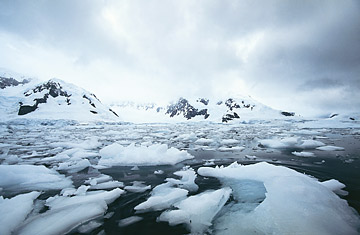
Ice floating in Paradise Bay, Antarctic Peninsula
(7 of 10)
Just as daunting as the cold are the loneliness and isolation in a land where phone lines are rare, mail is erratic, and penguins vastly outnumber people. Thousands of miles from friends and families, the residents of Antarctica are often confined to small areas around their bases. At many stations, living quarters are built underground so that they are protected from the wind. When storms force workers to stay indoors for days at a time, it amounts to their being trapped in a bunker.
But the bases try to make Antarctic life as enjoyable as possible. At McMurdo Station, the continent's largest town, the 1,100 or more summer residents can hang out at the four Navy bars, use a two-lane bowling alley, take aerobics classes at the gym, and borrow videotapes from a library. Recent social events included a chili-cooking contest and an amateur comedy night. Even at the South Pole Station, home to no more than 90 hardy workers, there is an exercise room, a sauna, a poolroom and a library equipped with wide- screen TV and a VCR.
Along about February the annual exodus begins in earnest. Once the cold season takes hold, planes stop making regular flights to inland stations, and the ice layer spreads out to sea, making access by ship nearly impossible. Only a few hundred residents stay through the winter.
The number of people who have gone to Antarctica is smaller than the attendance at this year's Rose Bowl game, but those few have had a disproportionately large impact. Because plants and animals, along with human outposts, are largely confined to the 2% of Antarctica that is ice-free for part of the year, the world's most sparsely populated continent is, paradoxically, overcrowded. The Antarctic Peninsula is particularly in demand, with 13 stations; King George Island, one of the South Shetland Islands, is home to an additional eight. Planes, helicopters, snowmobiles, trucks and bulldozers are in constant operation throughout the summer. Nearly every base has its own helipad, landing strip, harbor and waste dump.
The inhabitants of these bases have been notoriously careless, often discarding trash in ways that would be illegal at home. But their actions went largely unnoticed until January 1987, when Greenpeace became the first nongovernment organization to establish a permanent Antarctic base, located at Cape Evans, some 24 km (15 miles) north of McMurdo Station. The group has mounted annual inspection tours of dozens of bases. It was Greenpeace that publicized McMurdo's continued dumping of untreated sewage into the sea and burning of trash in an open-air pit. The waters right off the station are reportedly more polluted with substances such as heavy metals and PCBs than any similar stretch of water in the U.S. Greenpeace has also documented reckless dumping and burning at Soviet, Uruguayan, Argentine, Chilean and Chinese bases. And an airstrip under construction at France's Dumont d'Urville base has already leveled part of an Adelie-penguin rookery.