

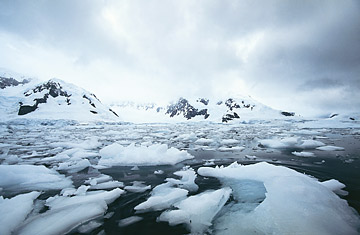
Ice floating in Paradise Bay, Antarctic Peninsula
(3 of 10)
The fragility of life in the Antarctic climate was dramatically underscored last January, when the Bahia Paraiso, an Argentine supply and tourist ship, ran aground off Palmer Station, spilling more than 643,450 liters (170,000 gal.) of jet and diesel fuel. The accident killed countless krill and hundreds of newly hatched skua and penguin chicks. Some 25 years of continuous animal population studies run by scientists at Palmer may have been ruined. Just weeks after the Bahia incident, the Peruvian research and supply ship Humboldt was blown by gale-force winds onto rocks near King George Island, producing an oil slick more than half a mile long.
Such disasters are shocking and unsettling to the hundreds of scientists in Antarctica, who had hoped the continent would remain their unspoiled natural laboratory. But they too bear much of the responsibility for the pollution that has soiled the area. Just three months ago, McMurdo Station, a U.S. base operated by the National Science Foundation, reported that 196,820 liters (52,000 gal.) of fuel had leaked from a rubber storage "bladder" onto the ice shelf. Over the past year or two, many bases have launched extensive cleanup campaigns, but scientists have yet to find the right balance between studying the Antarctic and preserving it.
No one disputes the importance of the research. The continent has a major -- though not completely understood -- influence on the world's weather. As Antarctica's white ice sheet reflects the sun's heat back into space, an overlying mass of air is kept frigid. This air rushes out to the sea, where the earth's rotation turns it into the roaring forties and the furious fifties -- old sailors' terms for the fierce winds that dominate the oceans between 40 degrees and 60 degrees south latitudes. If scientists can figure out just how these winds affect the global flow of air, then it will be easier to understand and predict the planet's weather.
Antarctica also provides the best-preserved fossil record of a fascinating chapter in the earth's history. Some 200 million years ago, during the Jurassic period, Antarctica formed the core of the ancient supercontinent now known as Gondwanaland. The name comes from Gondwana, a region in India where geological evidence of the supercontinent's existence was found. At the time of the supercontinent, Antarctica was nestled in the temperate latitudes and was almost tropical. It was covered by forests and filled with reptiles, primitive mammals and birds. But by 160 million years ago, the supercontinent had begun to break up. While most of the pieces, including South America, Africa, India and Australia, stayed in warm regions, Antarctica drifted to the South Pole.