

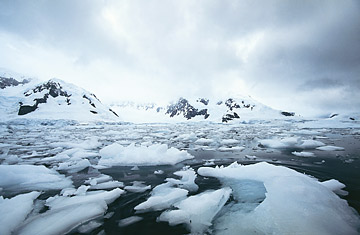
Ice floating in Paradise Bay, Antarctic Peninsula
(2 of 10)
The focus of contention at the moment is the Wellington Convention, an international agreement that would establish rules governing oil and mineral exploration and development in Antarctica. Proponents say the convention, painstakingly drafted during six years of negotiations, contains stringent environmental safeguards. But many environmentalists see the convention as the first step toward the dangerous exploitation of Antarctica's hidden store of minerals. They argue that the continent should be turned into a "world park" in which only scientific research and limited tourism would be permitted.
That position did not garner much support until last spring, when France and Australia, two countries with a major presence in Antarctica, suddenly announced that they backed the world-park idea and would not sign the Wellington Convention. In Washington, Senator Albert Gore of Tennessee is leading a drive to get the U.S. to withdraw its support of the accord. Until the debate is resolved, there will be no agreed-upon strategy for protecting Antarctica from mineral exploration.
Meanwhile, some of the harm already done will not easily be repaired and may have far-reaching impact. For many years, the industrial nations have been releasing chlorofluorocarbons into the atmosphere, not realizing that these chemicals were destroying the ozone layer, which shields the earth from harmful ultraviolet radiation. Because of the vagaries of air currents, ozone depletion has been most severe over Antarctica. It was the discovery in 1983 of an "ozone hole" over the continent that first alerted scientists to the immediacy of the CFC threat.
Since then, researchers have been monitoring the hole and looking for similar ozone destruction over populated areas. Scientists predict that thinning ozone, and the resulting increase in ultraviolet radiation, will cause damage to plants and animals, as well as skin cancers and cataracts in humans. To keep a bad situation from getting worse, nations are working on an international agreement designed to phase out production of CFCs by the year 2000.
In the meantime, researchers have been carefully studying the effects of ozone depletion on Antarctic life. Marine ecologist Sayed El-Sayed of Texas A& M University discovered two years ago at Palmer Station, a U.S. base on the Antarctic Peninsula, that high levels of ultraviolet damage the chlorophyll pigment vital for photosynthesis in phytoplankton, slowing the marine plants' growth rate by as much as 30%. That, in turn, could threaten krill, shrimplike creatures that feed on phytoplankton and are a key link in Antarctica's food chain. Says El-Sayed: "Fish, whales, penguins and winged birds all depend very heavily on krill. If anything happened to the krill population, the whole system would collapse."