

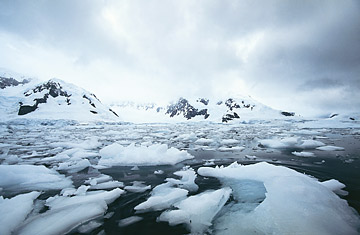
Ice floating in Paradise Bay, Antarctic Peninsula
(8 of 10)
The charges have some validity, says Erick Chiang, senior U.S. representative in Antarctica, but they are exaggerated. "Our behavior in the past was disgraceful -- by today's standards," he admits. "But we are doing much better. We're installing a primary waste-treatment facility at McMurdo this season. We've begun recycling. Yes, we lost 50,000 gal. of fuel recently, but we've recovered more than half of it." Last month McMurdo residents went patrolling for loose trash.
Chiang contends that despite past sins, the local ecology has not suffered very much. Some scientists agree. Says Cornelius Sullivan of the University of Southern California, who studies the algae that live in and under McMurdo Sound ice: "A few places are filthy. But most of the water is still absolutely pristine." Nonetheless, the National Science Foundation could do much better. One thing that will help: about $10 million was added to the agency's budget for 1990, bringing it to $152 million, and much of the new money will go toward protecting the environment.
While scientists try to clean up their act, tourists are posing an increasing threat to Antarctica's delicate ecosystems. Chilean planes began flying visitors to the peninsula in 1956, and luxury cruises started a decade later. Although commercial flights stopped after an Air New Zealand DC-10 crashed into Mount Erebus in 1979, killing all 257 aboard, ship travel has thrived. About 3,500 people, mostly Americans, paid $5,000 to $16,000 to sail over from South America last year. They generally stayed in Antarctica four or five days. Most boats carry naturalists or other experts, who give lectures, and groups often visit scientific stations. So many boats cruise along the peninsula between November and March that it has been dubbed the "Antarctic Riviera." Chile has opened a hotel near its base. Antarctic activities include hiking, mountain climbing, dogsledding, camping and skiing. A few show-offs have even water-skied on the cold waters.
The most intrusive visitors are those who tramp through penguin rookeries and other wildlife habitats. Going anywhere near certain kinds of seabirds can frighten them enough to disrupt feeding patterns and reproductive behavior. Though warned not to litter, some tourists leave behind film wrappers, water bottles and cigarette butts. And, yes, Antarctica has graffiti -- on the rocks of Elephant Island.
Responsible tour operators have come up with a code of conduct that forbids visitors to harass animals, enter research stations unless invited, and take souvenirs. Preservationists, like the Environmental Defense Fund's Manheim, argue in addition for strict limits on the size and frequency of tours and for civil and criminal penalties for operators who do not comply with the rules.