

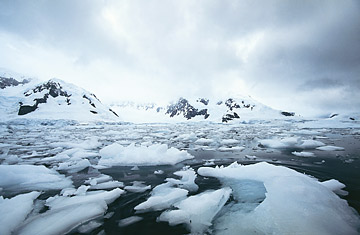
Ice floating in Paradise Bay, Antarctic Peninsula
From atop a windswept hill, the panoramic landscape looks eerily beautiful -- and yet completely hostile to life. Even at the height of summer, the scene is one of frigid desolation. To the west lies a saltwater bay whose surface is frozen solid. Beyond the bay loom glittering glaciers and towering, rocky peaks. On the south and east rises a blinding white shelf of permanent ice, so thick that it grinds against the seabed far below. And to the north is a snow- covered volcano that continuously belches noxious fumes. This is the bottom of the world, where winds can reach 320 kph (200 m.p.h.) and temperatures can plunge below -85 degrees C (-121 degrees F). This is Antarctica, the white continent, the harshest, most forbidding land on earth.
But the view from the hilltop, overlooking McMurdo Sound on the eastern side of Antarctica, is deceiving. A closer look at the seemingly lifeless land- and seascape reveals an amazing abundance of life. Like most of the coastal waters around the continent, McMurdo Sound is filled with plankton and fish, and its thick ice is perforated by the breathing holes of Weddell seals. Nearby Cape Royds is home to thousands of Adelie penguins, which hatch their eggs in the world's southernmost rookery. Skuas -- seagull-like scavenger birds -- scout the breathing holes and the margins between sea ice and land, seeking seal carcasses and unguarded baby penguins to feast on. The ice itself is permeated with algae and bacteria.
There is another sort of life as well. All around Antarctica the coast is dotted with corrugated-metal buildings, oil-storage tanks and garbage dumps -- unmistakable signs of man. No fewer than 16 nations have established permanent bases on the only continent that belongs to the whole world. They were set up mainly to conduct scientific research, but they have become magnets for boatloads of tourists, who come to gawk at the peaks and the penguins. Environmentalists fear that miners and oil drillers may not be far behind. Already the human invaders of Antarctica have created an awful mess in what was only recently the world's cleanest spot. Over the years, they have spilled oil into the seas, dumped untreated sewage off the coasts, burned garbage in open pits, and let huge piles of discarded machinery slowly rust on the frozen turf.
News of the environmental assaults has unleashed a global wave of concern about Antarctica's future. "It is now clear that the continent's isolation no longer protects it from the impact of man," declares Bruce Manheim, a biologist with the Environmental Defense Fund. How best to protect Antarctica has been a topic of fierce debate in meetings from Washington to Wellington, New Zealand. Everyone agrees that the issue is of great importance and urgency. Despite the damage done so far, Antarctica is still largely pristine, the only wild continent left on earth. There scientists can study unique ecosystems and climatic disturbances that influence the weather patterns of the entire globe. The research being done on the frozen continent cannot be carried out anywhere else. "In Antarctica we still have the chance to protect nature in something close to its natural state and leave it as a legacy for future generations," says Jim Barnes, a founder of the Antarctic and Southern Ocean Coalition, an alliance of more than 200 environmental groups.