

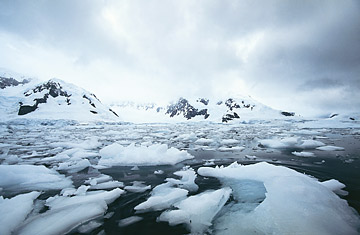
Ice floating in Paradise Bay, Antarctic Peninsula
(10 of 10)
Nonratification by either France or Australia would automatically kill the Wellington Convention. But that does not guarantee that the world-park concept, as good as it would be for Antarctica's environment, would replace the defeated agreement. Some Antarctic Treaty nations oppose a permanent ban on mineral development -- notably Britain, which has the same veto power as France and Australia. That raises the possibility that the world will be left with no agreement at all on the minerals question, not even the informal moratorium on exploration and mining adopted in 1977 until a convention could be ratified. Antarctica might thus be opened to wholly unregulated mining.
That is a frightening prospect, so alarming that the nations subscribing to the Antarctic Treaty cannot afford to let it happen. The Wellington Convention may not be perfect, but it should be ratified. Far from a license to exploit, it would serve as a major roadblock to development and could be strengthened by further conventions specifying more stringent protection -- even by the creation of the same environmental watchdog agency suggested by world-park proponents. The real problem with the Antarctic Treaty system is that the rules are not always strictly enforced, and there is no reason to think that nations would pay any more attention to the provisions of a world-park system than they do to existing regulations.
In the end, the only way to save Antarctica is to convince the countries operating there -- and those that join them in the future -- that it is not worth fouling the only relatively untouched continent left on earth to gain a few extra barrels of oil. The environmental activists have done much to make that point, and governments seem to be listening. This may be the place where mankind finally learns to live in harmony with nature. If so, the forbidding vistas of Antarctica may be just as full of life a century from now as they were when humans first set foot on that continent less than 200 years ago.