

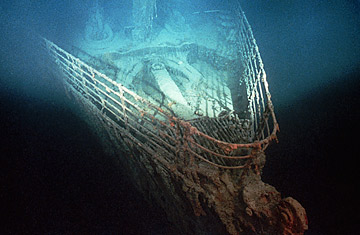
On Sept. 1, 1985, underwater explorer Robert Ballard located the world's most famous shipwreck. The Titanic lay largely intact at a depth of 12,000 ft. off the coast of St. John's, Newfoundland
(9 of 11)
More advanced craft are on the way. The Navy's National Ocean Systems Center in San Diego is developing ROVs that operate free of a tether. These AUVs--autonomous underwater vehicles--will be programmed for missions before they are dropped overboard. "The next step," says Howard Talkington, head of NOSC's engineering and computer science department, "is to do away with the umbilical cord and operate the ROV completely in a robotic manner."
ROVs and other high-tech underwater equipment are no longer the exclusive province of oil companies and the military. Hydro Products of San Diego markets for only $35,995 a 56-lb. model equipped with a panning and tilting color- TV camera and capable of diving to 330 ft. Says Hydro Products Executive Bob McKee: "You can just throw it into the back of your pickup, run out to the site and throw it into the water." Prices are also dropping for such devices as side-scan sonar, which generates high-resolution images of the ocean bottom, and sub-bottom sonar, which can distinguish the shape of buried objects.
Treasure hunters are delighted by the trend, which has made many previously unreachable or unknown offshore wrecks accessible to enterprising amateurs. But scientists are becoming agitated. "This technology is out of control," Ballard told a congressional hearing last year. Says Helen Hooper, a consultant for the Society for Archaeology: "There's a mini-gold rush going on right now, and it's endangering some of the more important sites. We're afraid that if there isn't some slowing down of this treasure hunting, there won't be anything left."
George Bass and other archaeologists worry not only about the looting of rare artifacts but about the damage done by treasure hunters, most of whom care little about the remnants of the sunken ships. The scientists, accustomed to removing artifacts gingerly, carefully digging with spoons and even their fingers, are particularly horrified by the use of mailboxes, which can blow 3- ft. to 6-ft. holes in the sand, scattering artifacts.
The barrage of criticism has had its effect on big-time treasure hunters; even Fisher now includes archaeologists in his crew. At the Atocha site, Archaeologist Duncan Mathewson is carefully noting the position of each artifact and labeling each find. He has marked the site with grids, using yellow tape and pipes, and pinpointed each piece of the ancient hull.
Archaeologists are particularly concerned about the buried remains of wooden hulls, the part of the ship that has sunk into the seabed or been covered by drifting sand or silt and thus preserved. These remnants, which deteriorate rapidly when exposed to the open sea, provide a wealth of information to scientists. Says Richard Steffy, an INA ship reconstructor: "Ships were the most complex structures made by these societies. When you look at the remains of a ship, you're looking at a very high degree of technology within that period." Working with a crew of assistants and archaeologists, Steffy sketches the shape of each surviving plank fragment, frame and other timbers as soon as possible after it is raised, then makes scaled-down copies of the pieces and fits them together. He has made a hypothetical reproduction of a ship's hull from 10% of the surviving timbers.