

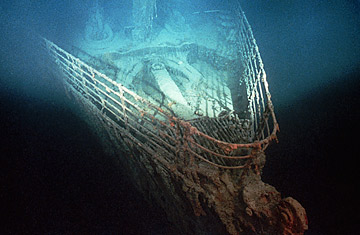
On Sept. 1, 1985, underwater explorer Robert Ballard located the world's most famous shipwreck. The Titanic lay largely intact at a depth of 12,000 ft. off the coast of St. John's, Newfoundland
(2 of 11)
While the exploration of the legendary Titanic captured the imagination of the world, it was but one of many undersea forays now in progress. Even as J.J. roamed the corridors of the great ship, diving teams from Cape Cod, Mass., to the South Seas, wearing scuba tanks, masks and flippers, were peering at decaying wrecks on the sea floor. At depths ranging from dozens to hundreds of feet, they probed and photographed the remnants of rotting hulls and carefully marked the location of scattered debris like cannonballs, silver bars or shattered pottery. Returning to the surface, they often brought with them priceless artifacts of ancient civilizations.
Armed with sophisticated equipment that enables them to locate and descend to long-lost shipwrecks, explorers are providing fascinating insights to the past. "We are opening up an enormous new era in archaeology," says Navy Secretary Lehman. "We now have time capsules in the deep oceans."
The incentives for undersea exploration extend beyond the historical and archaeological benefits. High-tech fortune hunters are locating sunken treasure ships and recovering their precious cargo. New remote-controlled vehicles are prowling the ocean depths, some dropping listening devices and scouting out potential hiding places for missile-firing submarines. Others are seeking mineral deposits and clues to the movement of the earth's tectonic plates, and charting the two-thirds of the earth's surface that until recently has been largely inaccessible to man.
Still, for all the worldwide activity in the deep, last week nothing could compete for attention with the trove of photographs, videotape and lore accumulated during the Titanic mission. Each of Alvin's 100-ft.-per-minute descents from the mother ship Atlantis II required 2 1/2 hours, during which Ballard tried to relax by listening to the recorded music of Edvard Grieg. On the first dive, the submersible, carrying J.J. down with it, approached the Titanic's 60-ft.-high starboard midsection. "That was the first thing we came in on," recalls Ballard. "We were putting our nose right up against this massive wall." Later, viewing the mangled remnants of the severed stern through Alvin's Plexiglas porthole, he was shaken. "You really felt it when you were there, the sheer carnage," he says. "It looked violent and destructive. The bow is majestic. It still has some nobility. But the stern . . . "
Between the two sections of the ship, the Woods Hole scientists found a large debris field littered with artifacts: a copper kettle polished by sand particles in the deep-sea currents; three of the ship's safes; a porcelain doll's head; a patent-leather shoe. Most of the ship's woodwork had been devoured by marine creatures. Amid the debris were at least four of the Titanic's huge boilers; an unbroken porcelain coffee cup rested on one of them. Says Ballard: "It must have fluttered down like a leaf and settled on the boiler, which had come crashing down."