

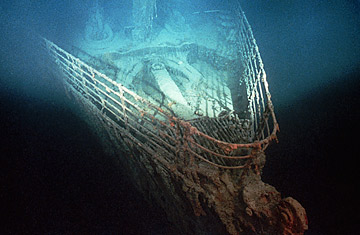
On Sept. 1, 1985, underwater explorer Robert Ballard located the world's most famous shipwreck. The Titanic lay largely intact at a depth of 12,000 ft. off the coast of St. John's, Newfoundland
(6 of 11)
His team painstakingly swept 120,000 linear miles of ocean with magnetometers, devices that detect irregularities in the earth's magnetic field--anomalies caused by, among other things, iron cannons, armor or anchors. They used side-scan and sub-bottom sonar and even commissioned an aerial survey, but the search did not yield a verifiable Atocha remnant. Says Fay Feild, an engineer and consultant to Treasure Salvors, who designed a special magnetometer for Fisher: "With a magnetometer, even in a limited area, only one in 100 'hits' has anything to do with a wreck. With a side- scanner, it's one in a million."
Fisher's team found the first certifiable remains of the Atocha in 1973, matching the identifying number on a recovered silver bar with one listed in the ship's manifest in the Seville archives. But because the cargo was scattered over nine linear miles, it took Fisher until 1985--and a total of 6,500 magnetometer hits--to identify what he calls the "mother lode," the ; main body of the ship's cargo. Even then, retrieving the treasure was difficult. The deeper waters off the Florida Keys are murky, the bottom heavily silted. Again, technology provided the solution. Several years earlier, Feild had devised a huge pair of fittings that resemble and are called mailboxes, and placed them over the propellers of one of Fisher's tugs, in effect directing the ship's backwash straight down and forming a clear vertical column of water extending to the sea floor. The mailboxes not only improved visibility below but washed away silt and sand. Fisher's divers have been further equipped with an air lift, a long plastic tube that clears sand away with a blast of compressed air. Still, the search was arduous--and costly to Fisher, both financially and emotionally; in 1975 his oldest son, his daughter-in-law and a crew member were drowned when a tug used in the quest capsized during a storm.
Fisher's 1,200 or so stockholders and investors are due for a handsome return. The booty that divers have raised includes 3,200 emeralds, one-third of which are top-quality stones, 150,000 silver coins, and more than 1,000 silver bars that average 85 lbs. each. They have also recovered other kinds of treasure: bronze cannons, potsherds, navigational instruments and kitchen utensils. Total estimated value of the find: more than $400 million.
Professional Salvor Barry Clifford, 41, is running Fisher a close second in treasure hunting. Some 30 ft. down and only 1,200 ft. out from the sunbathers on Cape Cod's Marconi Beach, Clifford is salvaging booty from the Whydah, a 100-ft.-long pirate galley that foundered on a sandbank in 1717. "Everyone grew up knowing the story," recalls Clifford, who first heard the tale of sunken treasure from his crusty, Cape Cod-born uncle. "She was part of our lore."