

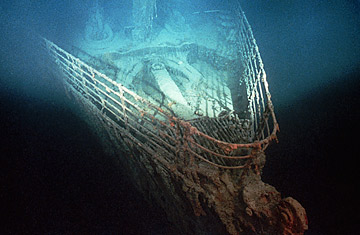
On Sept. 1, 1985, underwater explorer Robert Ballard located the world's most famous shipwreck. The Titanic lay largely intact at a depth of 12,000 ft. off the coast of St. John's, Newfoundland
(7 of 11)
Clifford began his search for the Whydah in 1982. Armed with an exclusive permit from the state of Massachusetts, he concentrated on a 2-sq.-mi. area, using a magnetometer and side-scan sonar. In the summer of 1983 divers found a clay pipestem, brass nails and some rudder strapping. But try as he might, Clifford could not convince everyone that the artifacts were from the Whydah and not from any of the countless other ships that have been wrecked off the Cape. Even the 1984 discovery of three cannons failed to satisfy Clifford's critics. But last fall, while surveying the underwater site, Rob McClung, a former Aspen, Colo., police chief, caught his finger on the rounded rim of a large object. It proved to be a 200-lb. concreted ship's bell, which, when cleaned of some of its heavy crust, revealed the words THE WHYDAH GALLY--1716. Says Clifford: "There's a lot of crow being served out in copious portions."
And copious treasure too. Aided by mailboxes, divers labored continuously last week, bringing up more of the Whydah's riches. "There's a lot of work, a lot of hours," says Diver Todd Murphy, 28. "No weekends. No holidays."
But the payoff is well worth the trouble. The divers have retrieved more than $15 million in silver coins, gold dust, and artifacts; the Whydah's bell alone has been appraised at $5 million. Clifford, who has meticulously studied the manifests and other records of the 50-odd ships plundered by the Whydah's captain before his ship sank, estimates that the loot still in the sand is worth $380 million more. It includes 500,000 to 750,000 silver coins, 10,000 lbs. of gold dust, a casket of "hen's-egg-size East Indian jewels" and some African ivory.
The world became aware that a new era under the sea was dawning in 1954, when National Geographic published an article titled "Fish Men Discover a 2,200-year-old Greek Ship." The author was a Frenchman named Jacques-Yves Cousteau, who in 1943 had helped to invent the Aqualung--the precursor of self-contained underwater breathing apparatus (scuba)--and used it to excavate a vessel at the bottom of the Mediterranean near the island of Grand Congloue. "That opened the door to underwater exploration for the modern day," says Wilbur Garrett, editor of National Geographic, the venerable publication of the National Geographic Society, which has since financed many undersea missions by Cousteau and others. In 1959 Cousteau invented the first small submersible, a battery-powered diving saucer propelled by jets of water that could safely carry a two-person crew to a depth of 1,000 ft.
A disaster, not exploration, spurred development of more versatile undersea vessels like Alvin and J.J. In 1963 the Navy's brand-new nuclear-powered submarine Thresher lost power and sank 220 miles east of Cape Cod with 129 on board. It took 1 1/2 years before a Navy search team, aboard the bathyscaphe Trieste II, finally located the sub resting 8,400 ft. down.
While Trieste II could reach great depths, it was little more than a spherical cabin suspended from a buoyant hull and capable of withstanding great pressures. But it was unable to rescue submariners or salvage vessels. What was needed, the Navy decided, was submersibles and ROVs able to maneuver at depths far in excess of 750 ft.