

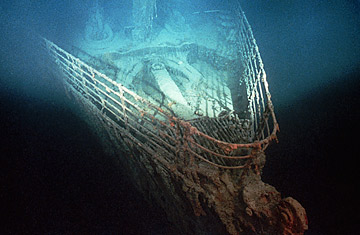
On Sept. 1, 1985, underwater explorer Robert Ballard located the world's most famous shipwreck. The Titanic lay largely intact at a depth of 12,000 ft. off the coast of St. John's, Newfoundland
(4 of 11)
While one diver, armed with a hammer and chisel, began chipping away around a copper ingot, trying to loosen it from concreted sediment, another culled the bottom, scooping sand with one hand and drawing it into a suction tube held in the other. Suddenly, something metallic flashed in the dim light filtering through the water. It was a piece of gold jewelry that had remained hidden from sight for 34 centuries. In the next several minutes, the team members uncovered more jewelry, a quartz bead, broken arrowheads and pottery shards, which they stored in a red-and-white plastic container. To mark the precise spot of each discovery, they poked bicycle spokes into the sand, then measured the distance between the spokes and fixed reference points. Knowing the exact location of each item will enable the archaeologists to map the site accurately.
Glancing at his watch, the leader signaled to the others, and the trio, using their flippers to rise, promptly began their ascent by following a cable that led up to the Virazon. Reaching a white marker cylinder at the 20-ft. depth, they stopped, treading water for three minutes, before rising again to a second marker, at the 10-ft. level. There they waited for eleven minutes, passing the time by penciling messages to each other on a roughened Plexiglas tablet. The scheduled pauses were decompression stops that allowed the excess dissolved nitrogen to leave their bodies gradually; in a faster ascent, the nitrogen would have come out of solution too rapidly, forming gas bubbles in the tissues or blood vessels, a painful and sometimes fatal consequence known as the "bends."
Back on deck, everyone crowded around as Bass and one of the divers opened the plastic container and examined a gold pendant bearing the image of a fanciful star with long wavy rays. "That's Canaanite," said Bass. "No question about it." On a smaller gold pendant was the figure of a woman with a tall headdress, wide skirt and both feet pointed to one side. "The figure's so Egyptian!" exclaimed Bass. "We've had three or four pendants like this on the expedition."
And much more. The ancient ship, whose origin Bass has not disclosed, was crammed with bronze, tin, glass, gold, quartz, weapons and dozens of amphoras (pottery jugs) containing goods ranging from frankincense to fruit seeds. "It was like a floating supermarket," says Yasar Yildiz, the deputy director of Turkey's Bodrum Museum of Underwater Archaeology, which is giving vital support to the INA expedition. "This wreck is more than we could hope for," says Archaeologist Cemal Pulak, Bass's assistant. "It is giving us all % kinds of new information about people's lives in this area in 1400 B.C., what goods they traded and where these goods were coming from." The discovery of glass ingots, for example, established conclusively that artisans were blowing glass in that region far earlier than had previously been thought. The ancient vessel itself has been a rich source of information. Says Bass: "It extends our knowledge of ship technology back a thousand years."
Halfway around the world from Turkey, other nautical archaeologists were at work last April off Vanikoro, a 300-sq.-mi. island in the southwestern Pacific's Solomon chain. The setting was pure Indiana Jones: mosquito-infested jungles; rivers teeming with crocodiles; heavy, brooding clouds hovering over an inhospitable landscape.