

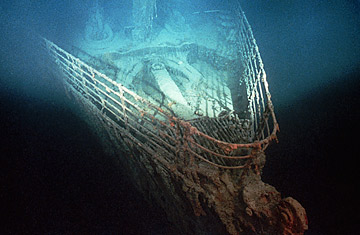
On Sept. 1, 1985, underwater explorer Robert Ballard located the world's most famous shipwreck. The Titanic lay largely intact at a depth of 12,000 ft. off the coast of St. John's, Newfoundland
(8 of 11)
By 1964 the Navy had launched the first, and still most famous, of the new submersibles, Alvin. Operated by Woods Hole, the 23-ft.-long craft could carry three people to a depth of 6,000 ft., pick up objects with an arm and claw, and roam the sea floor at a speed of one knot (Alvin has since been lengthened to 25 ft. and given a second arm-claw, as well as a new pressure hull that enables it to operate as far down as 13,120 ft.). The stellar performance of the tiny sub during the second Titanic mission was only the latest in a long list of accomplishments. Among the more remarkable of Alvin's 1,716 deep-sea missions: locating and helping to recover (from a depth of 2,850 ft.) an H- bomb that fell into the Mediterranean after a B-52 bomber and a KC-135 tanker collided over Spain in 1966; discovering peculiar new life-forms, including tube worms 10 ft. long, while probing hot-water vents in the ocean floor 8,000 ft. below the surface of the Pacific.
Over the years, Alvin has been joined in the seas by dozens of other manned submersibles, most of them American or French. The deepest operational diver of them all is the U.S. Navy's 31 1/2-ft., 58,000-lb., three-man Sea Cliff, which can safely carry its crew to a depth of 20,000 ft. Its manipulator arms can operate a variety of underwater tools, including a drill, a cable cutter, scissors, and plier-like jaws that can grasp sunken torpedoes, as well as attach cable slings to raise heavier objects such as downed aircraft.
This month Sea Cliff will embark on a mission for the U.S. Geological Survey in the Gorda Ridge off the coast of California and Oregon. Descending to 13,000 ft., it will enable scientists to get a close-up look at nodules of manganese and other metals that build up near geologically active breaks in the earth's crust. In the future, even more versatile undersea craft will be used to mine these minerals and bring them to the surface.
J.J.'s performance on the Titanic mission drew attention to the potential of remotely operated vehicles, which are not only supplementing the work of manned submersibles but in many cases replacing them. ROVs became popular during the 1973 oil crisis, when companies were forced to search for new petroleum reserves beneath the sea. Most are self-propelled. They are connected to the mother ship by a cable, through which they receive electricity and commands from their human pilot and transmit pictures and data. It was an advanced ROV, the Gemini, that played a key role in the recovery of wreckage from the space shuttle Challenger. Designed to operate at depths as great as 5,000 ft., the 7,000-lb. ungainly craft uses hydraulic thrusters to maneuver like an underwater helicopter. It has two mechanical arms and is loaded with high-tech equipment. Its three cameras and two sonar systems give controllers on the surface a sweeping view of the depths.
Last year two other sophisticated U.S. ROVs, Scarab 1 and Scarab 2, reached the wreckage of Air-India Flight 182, which plunged into the North Atlantic 110 miles southwest of Ireland on June 23. Scarab 1 located and retrieved the 747's voice and flight-data recorders from a spot 6,700 ft. deep, while Scarab 2 mapped and photographed the wreckage, some of which was later retrieved. Their achievements enabled experts to determine that the jet's forward baggage hold had been ripped apart in the air, almost certainly by a bomb.