

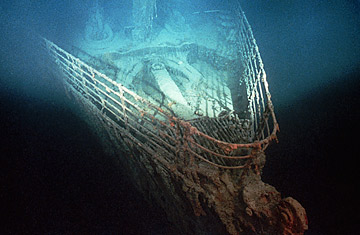
On Sept. 1, 1985, underwater explorer Robert Ballard located the world's most famous shipwreck. The Titanic lay largely intact at a depth of 12,000 ft. off the coast of St. John's, Newfoundland
(5 of 11)
Two miles offshore and 15 ft. to 140 ft. down the steeply sloping bottom lie the remains, partly enveloped in coral, of the Boussole and the Astrolabe, the flagship and companion frigate of one of France's greatest 18th century navigators, Count Jean Francois de la Perouse. Louis XVI had dispatched the aristocrat to the Pacific in 1785, hoping that his discoveries would rival those of British Explorer Captain James Cook. As Louis was led to the guillotine eight years later, he supposedly inquired, "Has there been any news of La Perouse?" Each morning 20 divers from a multinational team, led by researchers from the Queensland Museum in Brisbane, Australia, and historians from Noumea, New Caledonia, left three chartered boats anchored in Vanikoro's lagoon and sped in inflatable outboards to the wreck site. In the afternoons, they returned laden with artifacts that included part of a shoe, Chinese ceramics, a dragoon's brass helmet and thousands of glass necklace beads probably intended as items of barter for Pacific tribal chieftains.
A highlight of the mission for Chief Archaeologist Scott Sledge, 38, was the discovery of a brass regimental facing plate, a shieldlike ornament from a soldier's bearskin cap, with the word royal clearly distinguishable. After gingerly brushing away some silt, Sledge recalls, "I came across something shiny right underneath." It was embedded in the surrounding coral, which he had to chip away carefully. Just as he was about to give up for the day and return to the surface, the plate loosened, and he was able to slide it out of the coral in perfect condition. Says Sledge: "That, to me, was extremely exciting and of more value to an archaeologist than a chest full of diamonds and gold."
Fortune Hunter Mel Fisher might argue about that appraisal. Some 30 miles out from Key West in the Gulf of Mexico, his four salvage tugs lay at anchor last week 60 ft. above the remains of the Spanish galleon Atocha. The square-rigged vessel sank in a hurricane in 1622, carrying 260 crew members and passengers, and a priceless cargo, to the bottom. From the tugs, divers employed by Fisher's Treasure Salvors, Inc., have brought to the surface a fortune in emeralds, gold and silver bars, coins, bags of gold dust and lengths of golden chains.
Fisher, 64, has earned his reward the hard way. He first read about the wrecked Spanish treasure galleons Nuestra Senora de Atocha and her sister ship Santa Margarita in 1960 in the Treasure Hunter's Guide, which included references to the two ships sinking off the "Keys of Matecumbe" in a 1622 hurricane. Several years later Fisher met Eugene Lyon, who was beginning research for a doctoral dissertation on the history of the Spanish conquest of Florida. Lyon was about to leave for Seville to study Spanish archives, and Fisher enlisted his aid in the search for the galleons. The researcher eventually wrote from Spain that he had good evidence Matecumbe was a general term for the Florida Keys. He suggested that the treasure lay off what are now known as the Marquesas.
Fisher, who had already had some success salvaging treasure from wrecks off Vero Beach, promptly moved to Key West. In 1970 he launched a 16-year, high- tech search for the Spanish ships.