

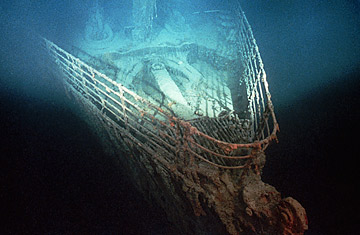
On Sept. 1, 1985, underwater explorer Robert Ballard located the world's most famous shipwreck. The Titanic lay largely intact at a depth of 12,000 ft. off the coast of St. John's, Newfoundland
After resting on the ocean floor, split asunder and rusting, for nearly three- quarters of a century, a great ship seemed to come alive again. The saga of the White Star liner Titanic, which struck an iceberg and sank on its maiden voyage in 1912, carrying more than 1,500 passengers to their deaths, has been celebrated in print and on film, in poetry and song. But last week what had been legendary suddenly became real. As they viewed videotapes and photographs of the sunken leviathan, millions of people around the world could sense her mass, her eerie quiet and the ruined splendor of a lost age.
Watching on television, they vicariously joined the undersea craft Alvin and Jason Jr. ("J.J.") as they toured the wreckage of the luxury liner, wandering across the decks past corroded bollards, peering into the officers' quarters and through rust-curtained portholes. Views of the railings where doomed passengers and crew members stood evoked images of the moonless night 74 years ago when the great ship slipped beneath the waves.
The two-minute videotape and nine photographs, all in color and shot 12,500 ft. under the North Atlantic, were a tiny sample of the 60 hours of video and 60,000 stills garnered during the twelve-day exploration. They were released at a Washington press conference conducted by Marine Geologist Robert Ballard, 44, who led the teams from the Woods Hole Oceanographic Institution that found the Titanic last September and revisited it this July.
Recounting the highlights of what has already become the most celebrated feat of underwater exploration, Ballard revealed some startling new information. His deep-diving craft failed to find the 300-ft. gash that, according to legend, was torn in the Titanic's hull when the ship plowed into the iceberg. Instead, he suggested, the collision had buckled the ship's plates, allowing water to pour in. He also brought back evidence that the ship broke apart not when she hit bottom, as he had thought when viewing the first Titanic images last September, but as she sank: the stern, which settled on the bottom almost 1,800 ft. from the bow, had swiveled 180 degrees on its way down.
Between the pictures shot by cameras aboard the submersible Alvin, the remotely operated vehicle (ROV) J.J. and the towed sled Angus, Ballard said, "there is not a square inch of the Titanic that has not been photographed in beautiful detail." Woods Hole scientists plan to create a photomosaic of the entire ship, a project that will take several months. But Secretary of the Navy John Lehman, whose department financed the expedition, had already seen enough. Delighted with the spectacular outcome, he declared Ballard the Navy's "Bottom Gun" and presented him with a duly inscribed navy blue baseball cap.