

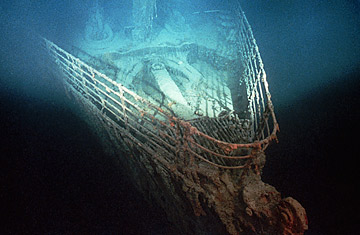
On Sept. 1, 1985, underwater explorer Robert Ballard located the world's most famous shipwreck. The Titanic lay largely intact at a depth of 12,000 ft. off the coast of St. John's, Newfoundland
(10 of 11)
In Britain, a group of marine archaeologists has more to work with. When they located the 16th century warship Mary Rose (which sank in 45 ft. of water off Portsmouth in 1545) and raised it in 1982, half of the hull had been buried under protective silt for centuries. The waterlogged structure, part of which had the consistency of wet cardboard, was moved into dry dock at the Portsmouth Naval Base, and has since been sprayed constantly with a cold-water mist to keep the wood from disintegrating in the air. This treatment will continue for another three years, after which polyethylene glycol, a waxy preserving agent, will be included in the mist in gradually increasing amounts. When the spray is finally turned off in the year 2001, the historic hull should be able to stand on its own.
For all the excavation and salvaging now under way, thousands of sunken ships remain undiscovered and many others unexplored. A few rank particularly high on the wish lists of marine archaeologists and treasure hunters. For four years an INA team led by Archaeologist Roger Smith has been scouring Jamaica's St. Ann's Bay for two of Columbus' caravels thought to have been intentionally run aground in 1503. "The caravels that Columbus sailed to the New World were the Mercury space capsules of their day," he says. "And somewhere beneath the soft sediments of this bay there are not one but two of those ships."
Queensland Museum archaeologists are planning an expedition this fall to the Pandora, an 18th century British navy frigate that lies 75 miles east of Australia's Cape York Peninsula. When Pandora sank in 1791, it is thought to have carried to the bottom four captured mutineers from H.M.S. Bounty shackled in irons. Since the wreck was discovered nine years ago, it has yielded some 800 well-preserved artifacts. But a shortage of funds cut off exploration two years ago. "If the funding continues," says Peter Gesner, the museum's assistant curator of maritime archaeology, "we can expect to end up with tens of thousands of artifacts."
Barry Clifford's new goal is to salvage H.M.S. Hussar, a British pay ship that sank in 80 ft. of water in the East River off Manhattan in 1780 laden with a cargo of gold that some experts estimate to be worth $500 million. Clifford has been granted an initial exploration permit for the Hussar by New York State, and expects to begin probing the river's treacherous five-knot currents and polluted water this week.
Now that Robert Ballard has proved that artifacts from the Titanic can be salvaged ("It would have been easy to retrieve those things," he said last week), the great ship may become a target for treasure hunters. Texas Oil Baron Jack Grimm, who between 1980 and 1983 spent a total of $2 million on three failed missions to find the Titanic, announced last week that he plans to use a submersible next summer to retrieve Titanic relics. "The selling of them I'm not particularly interested in," he says. "I'll probably donate them to different museums or put them on display around the country for mankind to view and remember the tragic events that occurred on that night."