

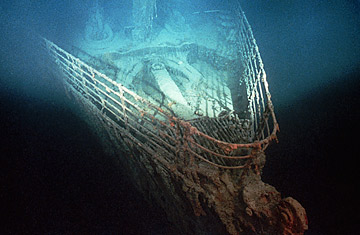
On Sept. 1, 1985, underwater explorer Robert Ballard located the world's most famous shipwreck. The Titanic lay largely intact at a depth of 12,000 ft. off the coast of St. John's, Newfoundland
(3 of 11)
It was one of these boilers that had led to the Titanic's discovery last year. For 22 days, the French vessel Le Suroit had "mowed the lawn," roaming over a 150-sq.-mi. target area with a sonar device that provides high- resolution maps of the seabed. After surveying 80% of the expanse, Le Suroit had found no trace of the wreck. Then Ballard's crew, joined by three French $ scientists aboard the U.S. Navy research vessel Knorr, began combing the remaining 20% with a sonar-and-video platform called Argo, which they towed behind the ship at a depth of 12,500 ft.
Early in the morning of Sept. 1, about an hour after Ballard had quit his post at the control center, the Knorr's cook awakened him, saying, "The guys in the van think you should come down." Ballard pulled on a jump suit over his pajamas and hurried to the control center. Seeing the video image of the boiler on the sea floor, he shouted, "That's it!" Once they spotted the boiler, the crew was able to locate the main section of the wreck with Knorr's echo sounder, a device similar to ones found on deep-sea fishing boats the world over. They then determined the Titanic's exact latitude and longitude with a satellite navigation system accurate to within 100 ft.; it was to these coordinates that Ballard and his team returned in July.
Even as Woods Hole scientists were studying their hoard of images, another, far more ancient ship was gradually giving up its secrets. Half a mile off the rocky cape of Ulu Burun, near the town of Kas, Turkey, three scuba divers from the research vessel Virazon splashed into the Mediterranean. The two Turks and an American are part of a team headed by George Bass, 53, of the Texas A & M-based Institute of Nautical Archaeology. For the past two years, a joint INA-Turkish team has been exploring one of the oldest ships ever found, a wooden craft that sank 3,400 years ago. It was not seen again until 1982, when a Turkish sponge diver spotted some of its cargo on the sea floor.
Aided by 24-lb. weights hanging at their waists, the divers needed only a few minutes to reach the sloping seabed where the fragmented keel rests, one end at a depth of 145 ft., the other at 170 ft. In between lie the remnants of the ship's cargo, embedded in rock and partly covered with sand.
Time was precious. At that depth, the divers had only about 15 minutes to work before beginning their return to the surface. Remaining below any longer would result in nitrogen narcosis; in the high-pressure environment of the deep, the blood and tissues absorb a larger than normal amount of nitrogen, causing a kind of tipsiness that dulls a diver's reactions. Explains Bass: "It's as if you had just tossed down three martinis."