

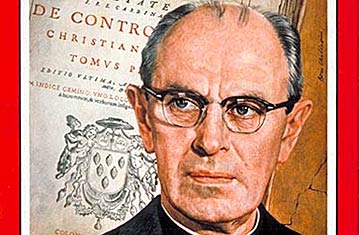
John Courtney Murray
(9 of 10)
After graduating from high school, where he specialized in debate and dramatics, John Murray abandoned his earlier aim to become a doctor and joined the Society of Jesus at 16. After taking his A.B. at Weston, Mass, and M.A. at Boston College, he taught for the order in the Philippines for three years, then he went to the Jesuit college at Woodstock, Md. for four years of theology. In his third year there, he was ordained, aged 28. He put in two years of theological graduate study at Gregorian University in Rome and various other centers of Catholic learning in Europe before taking up his lifework as professor of theology at Woodstock and editor (since 1941) of the learned quarterly Theological Studies. Thin, towering Father Murray is still the debater (and more subtly the actor) of his high school days. Lecturing to his classes of fledgling Jesuits at granite-grey Woodstock—where his major specialty is the Trinity—Theologian Murray makes effective use of his long, well-manicured hands and his well-pitched baritone, which is as clear as his well-organized thought.
A Human Good. Murray gave his polemical proclivities a workout in the early '50s with a scholarly drumfire of debate in the pages of the monthly American Ecclesiastical Review with its editor, Redemptorist Father Francis J. Connell, and Msgr. Joseph Clifford Fenton, professor of dogma at the Catholic University of America. The subject at issue: Murray's contention that the Vatican should give its formal blessing to the U.S. pluralist system as a new, permanent and viable kind of relationship between religion and government. The learned, footnote-stippled discussion ended when Murray was advised by his order that henceforth he would have to clear all his writings on this particular subject with Jesuit headquarters in Rome.
In his present book, carefully putting the matter in question form, Murray suggests that the .American system, including the American economy, is more than a material achievement to be held somewhat suspect from the spiritual point of view, but "a human good" and a limited "end-in-itself," recalling the 2nd century dictum of Irenaeus that "the material is susceptible of salvation."
Murray's good friend (and hot disputant), Protestant Reinhold Niebuhr, says warmly of him: "What makes Murray significant is that he thinks in terms of Catholic theology and the American tradition at the same time. He rejoices in being in the American tradition."
Burdened Conscience. The heirs to that tradition face a momentous choice today, as Murray sees it. The modern rationalist and pragmatist experiment, he feels, has failed. That experiment tried to carry on Western liberalism, whose roots are Christian, without Christianity. The individual conscience, lacking religion to inform and