

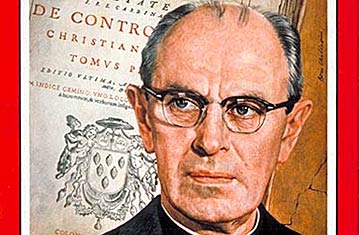
John Courtney Murray
(10 of 10)
But it may not go on. Few Protestants would accept Murray's notion of the fragility of the individual conscience—to them it is neither poor nor little, but under grace the indomitable center of faith. Yet among Protestants, and others, Murray discerns a sense that the "modern era" is over, and with it man's reliance on modern shibboleths—the inevitability of progress, the perfectibility of man on earth, the relativist idea that morality is determined by little more than regional or historical fashion. What is the "postmodern" era to be like?
It offers a major choice to man, says Murray. The choice is between the permanent "Christian revolution with all its hopes of freedom and justice" and the "reactionary counterrevolution" represented by rationalism. Man can either go on to a "new age of order," guided by the moral law, or he can go back to what Theologian Romano Guardini describes as the "interior disloyalty of modern times" —disloyalty not to a state, an ideal or even a faith, but a betrayal of the "structure of reality itself." In that event, the future will belong to a new incarnation of that "senseless, faithless, heartless, ruthless" man whom St. Paul met on the streets of non-Christian Corinth.
The Civil Dialogue. Murray is not guessing which choice will be made, and he is far from sure that the majority of Americans are prepared to accept even the terms in which he states the choice. His expectations, as he says, are minimal: he only hopes to "limit the warfare" of conflicting philosophies and "to enlarge the dialogue." For dialogue, as Murray sees it (and as did St. Thomas), is the very essence of civil society: what makes the multitude civilized is rational, deliberative argument among men ("We hold certain truths; therefore we can argue about them"). Writes Murray: "The cohesiveness of the City is not hot and humid, like the climate of the animal kingdom. It lacks the cordial warmth of love and unreasoning loyalty that pervades the family. It is cool and dry, with the coolness and dryness that characterize good argument among informed and responsible men."
For that kind of argument, Murray may be counted on. At present, he sees not even a "common universe of discourse." The various groups in the pluralist society do not share one another's premises or vocabulary so that only confusion, not real disagreement, results: "Disagreement is not an easy thing to reach." If anyone can help U.S. Catholics and their non-Catholic countrymen toward the disagreement that precedes understanding—John Courtney Murray can.
* "When the Gentiles, which have not the law, do by nature the things contained in the law, these, having not the law, are a law unto themselves: which shew the work of the law written in their hearts, their conscience also bearing witness" (Romans 2:14,13),