

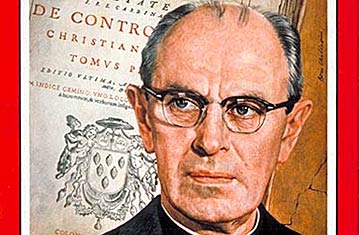
John Courtney Murray
(4 of 10)
Where is the act of purpose, the work of thought to come from? Even with the will to achieve it, deliberately acquiring a consensus may sound as absurd as deliberately deciding to fall in love. But for those about to embark regretfully on a dubious, consensusless future, Father Murray has a further word. "It just happens," he says in effect, "that I have here a device which any reasonably intelligent person may apply to lead him to the consensus, the public philosophy." And with an urbane, engaging smile, out of his long black clericals he pops it: natural law.
God's Reason. The concept of a law of man's nature prior to the "positive" laws he enacts has meant many things to many thinkers. It is a pre-Christian notion, going back farther than Aristotle, and in the Christian era it is by no means exclusively Catholic. But it was Thomas Aquinas who shaped and polished the idea into one of the strongest and most subtle instruments of civilization.
There is an eternal law, he held, which is God's reason governing the interrelationship of all things. This eternal law has two divisions—divine positive law, accessible to man only through revelation, and natural law or moral law, directly accessible to man through his reason (which, according to the Thomist theory of analogy, bears some relationship to God's). Natural law governs man's relationship to God and to his fellow man.
The criteria of good and evil are to be found in man's nature; man is naturally a social being; therefore the good of society is man's good. Theft, for example, is wrong because it subverts the basis of social life, as does any private injury to another. When there is conflict between the satisfaction of two natural requirements, the rational (therefore the lawful) course is to subordinate the lower to the higher. Thus self-preservation is good, but to refuse to risk one's life when the well-being of society demands it is wrong.
Elementary life situations confront even the child with the opportunity to reason out the good to be done and the evil avoided. For instance, says Father Murray, citing an example from St. Thomas, "To know the meaning of 'parent' and of 'disrespect' is to know a primary principle of the natural law, that disrespect to parents is evil, intrinsically and antecedent to any human prohibition." As experience unfolds, more and more precepts are derived—the basis of marriage, property, the state, the nature of justice. As human relationships become increasingly complex, the factoring-out of natural law eludes the unaided reason of the ordinary men. Such questions as the legitimate use of force, economic justice, the duties of employer and employee become the province of what St. Thomas called sapientes (the wise).
The Uses of Power. The wise are sometimes called upon to make painful revisions, for the content of natural law may change with time and circumstance. Throughout the Middle Ages, the practice of lending money at interest (usury) was held to be against natural law because money was considered naturally