

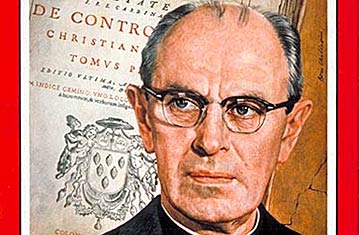
John Courtney Murray
See Cover: The all-conquering barbarians were storming the gates of Augustine's city when the saint died in 430. The North African town of Hippo was one of the last imperial outposts to be attacked. Rome had already gone under. Only four years before, St. Augustine's City of God had laid the theological groundwork for the church to step into the void left by the collapsing Roman Empire Ever since, Western civilization and the Christian enterprise have been joined together for better or worse; the church has moved and countermoved, advanced backtracked, tottered and triumphed before the contingencies of history. And the barbarian is seldom far from the city gates.
The barbarian is not necessarily known by his bearskin, his ax or his H-bomb nor does he always pound on his desk in a parliament of nations. He may be as urbane as the 18th century philosophers who prepared the way for the guillotine and the tumbrels. Or, in one man's words: He may wear a Brooks Brothers suit and carry a ballpoint pen ... In fact, even beneath the academic gown there may lurk a child of the wilderness, untutored in the high tradition of civility, who goes busily and happily about his work a domesticated and law-abiding man engaged in the construction of a philosophy to put an end to all philosophy This is perennially the work of the barbarian to undermine rational standards of judgment, to corrupt the inherited intuitive wisdom by which the people have always lived, and to do this not by spreading new beliefs but by creating a climate of doubt and bewilderment in which clarity about the larger aims of life is dimmed and the self-confidence of the people is destroyed."
In the considered view of the grave and learned man who wrote those words that is precisely what is happening to the U.S. John Courtney Murray sees his native America entering a new era of post-modern man" in a sorry state of ideological disarray that, unless repaired must doom the best political skill and dedication. His lucid, well-modulated concern for the U.S. has long ago earned him eminence among the cognoscenti with time for learned journals and debate Now in his first book, We Hold These Truths (Sheed & Ward; $5), he is entermg a new, broader area of influence. In the months to come, serious Americans of all sorts and conditions—in pinstripes and laboratory gowns, space suits and housecoats-will be discussing his hopes and fears for American democracy. This m itself betokens a new era in the U S For Author Murray is a Roman Catholic priest and a Jesuit.
Who Is Safe? It did not take the 1960 election to establish—though it well served to recall—what a unique encounter i diverse traditions is contained in the words "American Catholic." In the historical reality behind those words St Ignatius Loyola, founder of John Courtney Murray's order and soldier-saint meets Citizen Tom Paine, soldier-atheist. St. Thomas, the Angelic Doctor and patient builder of a great intellectual system, meets John Dewey, pragmatist and patient destroyer of systems. Monasticism, shielding a candle through the Dark Ages, meets the blaze of the Enlightenment. The Inquisition meets the Supreme Court, the apostolic succession meets the clapboard Congregationalist Church, the Sacred Roman Rota meets Reno.
Perhaps in no other society in history could these elements have endured together