

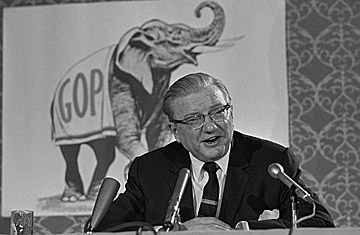
GOP National Chairman Ray Bliss
(9 of 10)
Romney at this point can count on probable convention support from a host of moderate G.O.P. Governors. Rockefeller urged a Romney-Javits ticket last spring. Colorado's Love, Massachusetts' Volpe, Pennsylvania's Shafer, Wisconsin's Warren Knowles and Rhode Island's Chafee—who sees a possibility of a Romney-Chafee combination—might throw him their convention votes. Vermont's Senator George Aiken states flatly: "I've held that Romney is the most promising man we have. He could win." Among other Republican Senators, New Jersey's Case, Kentucky's John Sherman Cooper, Hawaii's Hiram Fong and Maine's Margaret Chase Smith also are said to favor him.
Yet Romney, after four years in office, is still something of an unknown factor. He looks the part of a President and, as a devout Mormon, is morally about as upright as a candidate can be. But even those who lean toward him are not sure that he has the depth for the job, and some express concern over his tendency toward sanctimoniousness. One gag has an aide telling Romney, as the two emerge from a meeting, "Beautiful day, Governor." Romney's reply: "Thank you." Over the next 20 months, the undecided Republicans will be studying his performance with microscopic care.
"Which End?" The election galvanized a host of potential rivals. First in line: Richard Nixon, who labored mightily for Republican candidates during the campaign, only to be overshadowed when so many attractive new faces won so strongly. Nixon, by contrast, seems an all-too-familiar fixture, a candidate who has not won an election since 1956. He knows the track-perhaps a little better than he should. Asked about the presidential prospects of the party's bright new men, Javits said their chief drawback was that "they haven't been out on the track yet." Nixon's problem was the opposite. Likening him to a race horse, Javits said, "Well, they don't run them till they're two years old, and they rarely run them after they're six or seven." Moreover, as a two-time loser, however narrow the margins, he lacks popular appeal. "Here we are, the party people, just made for Dick Nixon," said an Indiana pro. "But go down the street and ask the people what they think of him. Not so much, I'll bet." Still, Nixon holds several trumps: he has earned the gratitude of hundreds of Republicans over years of doughty campaigning, and in the event of another conservative-moderate clash, he may be the only man acceptable to both sides.
Despite Rockefeller's disclaimers of persisting presidential ambitions, some pros are nervously watching him for signs of a relapse. Percy, yet to serve a day, has an eye on the chairmanship of the G.O.P. Senatorial Campaign Committee—the platform from which Barry Goldwater soared to prominence. Hatfield is also believed to harbor presidential ambitions. Reagan denied having any presidential plans, but did hint that he might go to the convention as a favorite son if there is "a need to avoid a divisive