

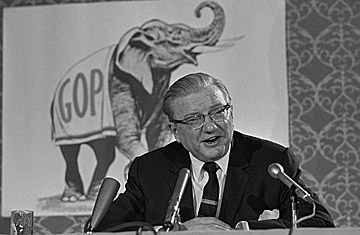
GOP National Chairman Ray Bliss
(6 of 10)
Because of his dovelike Viet Nam stand and a 5-to-4 edge in Democratic registration, Oregon's MARK HATFIELD, 44, had the toughest fight of the three, but emerged with 52% of the vote against Democrat Robert Duncan. Hatfield got himself into a hole at the beginning of his campaign by emphasizing his opposition to the war and by becoming the only dissenter from a pro-Administration resolution on Viet Nam at the Governors' Conference in July. "Any man who gauges his political viewpoints on where the votes are and who lets his career plans get in the way of his personal integrity—well, that man isn't a leader and he shouldn't win," he argued. His victory, in fact, stemmed less from the Viet Nam issue than from his wide and well-deserved popularity—a rare heritage for a Governor who has been in office for eight years.
Ideologically, Hatfield compares himself to the late Senator Robert A. Taft, "in that he was with the liberals on matters like public housing and aid to education, but was generally conservative." That puts him in much the same mold as Brooke and Romney. So does his emphasis on "self-help"—for individuals as well as governments.
Centrist Tradition. To Pennsylvania's Republican Senator Hugh Scott, the candidates' triumphs marked a restoration of the party's "centrist tradition." It was further cemented by the reelection of such G.O.P. Governors as Rhode Island's John Chafee, Colorado's John Love and South Dakota's Nils A. Boe, and by the emergence of such fresh faces as Arkansas' Winthrop Rockefeller, New Mexico's David Cargo, Pennsylvania's Raymond Shafer and Oregon's Tom McCall, the grandson of a former Massachusetts Governor.
In the Senate, the centrist trend was buttressed still further by Griffin's victory in Michigan, the landslide re-election of New Jersey's Case and Kentucky's John Sherman Cooper, and the upset victory in Tennessee of Howard Baker Jr., 41, over Governor Frank Clement. The first popularly elected Republican to the U.S. Senate in the state's history, Baker stands slightly to the left of his father-in-law, Ev Dirksen. "We must see that the Republican Party is so broadly based," he says, "that it can support widely divergent viewpoints and express 'the majority view.' "
Notwithstanding the G.O.P. gains, there was no overwhelming tide for either the conservative or moderate wings of the party. What was evident, instead, was some of the most selective, sophisticated voting in memory. Such was the extent of ticket splitting that Connecticut was the only state in all of New England in which the governorship and both houses of the legislature belonged to the same party. In Virginia, Negro voters gave Senator Harry Byrd Jr. a scant 18% of their votes, but went for Senatorial Candidate William Spong Jr., a racial moderate, by an overwhelming 91% .
The most notable trend was a vague feeling among Americans that after