

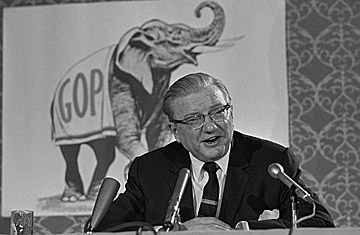
GOP National Chairman Ray Bliss
(7 of 10)
Rare Coalition. Neither of the issues that many observers considered pivotal —the "white backlash" and Viet Nam —had a profound effect on voting patterns. Of 25 Congressmen threatened by the backlash, according to a Congressional Quarterly survey, 17 emerged as winners, including Ohio's Republican William McCulloch, who played a major role in getting the 1964 Civil Rights Bill through the House. In
Georgia, Alabama and Florida, where Conservative Claude Kirk Jr. became the first Republican Governor in more than 90 years by borrowing George Mahoney's slogan, "Your Home Is Your Castle," backlash is hardly a suitable term; the racism was always there, needed no Negro demonstration to stir it up.
In two key contests, the race issue had a partial but by no means decisive influence. Reagan was helped in California by white reactions to riots in San Francisco and to open-housing laws, but he owed his election primarily to his "time-for-a-change" theme, his charismatic personality and skillful oratory. Though he advocated open-housing legislation, Chuck Percy profited both from white indignation over last summer's Negro demonstrations in Chicago and from Negro resentment over their sluggish progress under a Democratic city machine. But his real margin of victory was the contrast between his youthful activism and Paul Douglas' image of a well-meaning man who should have retired.
The backlash, said Urban League Executive Director Whitney Young, "did not materialize as much as many people had anticipated. American citizens, when the chips are down, prefer to vote their intelligence and good sense rather than their prejudices." In many races, in fact, there was something of a Negro "frontlash." Winthrop Rockefeller became the first Republican to win Arkansas' governorship by capturing 80% of the Negro vote—which turned out to be his margin of victory. South Carolina Democrat Ernest ("Fritz") Rollings' 10,000-vote margin for a U.S. Senate seat came mostly from Negro votes. In Maryland, Republican Agnew beat Mahoney on the votes of poor Negroes, upper-income Jews and Government workers from nearby Washington.
Fading Blue Collars. A major—perhaps decisive—factor in the G.O.P. resurgence was the fact that National Chairman Bliss's "cities strategy" was beginning to pay off. During the campaign, he conducted more than 50 "big-city workshops" for precinct