

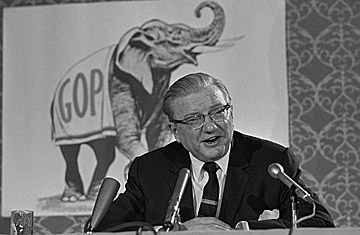
GOP National Chairman Ray Bliss
(5 of 10)
"Creative Moderate." Of the party's senatorial winners, none is likely to command more attention than Massachusetts' EDWARD BROOKE, 47, who once described himself as "a Protestant in a Catholic state, a Republican in a Democratic state and a Negro in a Caucasian state." He professes to be weary of hearing himself called "the first Negro this or the highest Negro that"—though he is certain to hear a lot more of it. "If I did confine myself to Negro problems," he says, "there would hardly ever be another Negro elected to public office except from a Negro ghetto, and justly so."
Brooke considers himself a "creative moderate," explains that he is "a liberal in civil rights and a conservative in fiscal matters." Strikingly handsome, with extremely light skin and hazel eyes, he is uncertain of his distant ancestry. "We never knew what we were," his Virginia-born mother says. After a middle-class upbringing in Washington's Brookland section (his father was a Veterans Administration lawyer), Brooke found himself in a nebulous no man's land between the white and Negro worlds; consequently, he is a reserved, often remote individual—despite his reputation as a formidable ladies' man. He married Remigia Ferrari-Scacco, an Italian girl, whom he met as a captain in the 366th Infantry Regiment, a Negro outfit, during World War II, has two daughters—one a blonde. Remigia's engaging Italian accent ("I think I never lose that," she says), helped him win a good share of Massachusetts' big Italian vote.
Brooke, who trounced ex-Governor Endicott Peabody by 436,000 votes, campaigned on the idea that "we can't have the so-called Great Society until we have the 'Responsible Society'—the society where it's more profitable to work than not to work. You don't help a man by constantly giving him more handouts." Though he complained at one point that he was "tired of hearing about backlash, and sidelash, and any other kind of lash" during the campaign, he was acutely aware of the impact it could have had—but did not—on his candidacy. "A vote for me is a vote against Stokely Carmichael," he said. "Civil rights cannot be obtained through the sword and bloodshed."
"Problem Solver." Like Brooke, Illinois' CHARLES PERCY eschews confining labels, prefers to call himself simply an "activist" and a "problem solver." The G.O.P., he says, should be "a party of proposition rather than opposition. My desire is always to have a plan that you're for, instead of getting preoccupied with being against." To three-term Democratic Senator Paul Douglas, 74, Percy was a "blank-check" candidate whose views were a mystery. Yet Percy pulled steadily ahead, won additional sympathy votes after his daughter, Valerie, 21, was slain in September in a still unsolved murder, and wound up with a 400,000-vote majority to spearhead a spectacular Republican comeback in the Midwest.
Percy, a Christian Scientist who became