

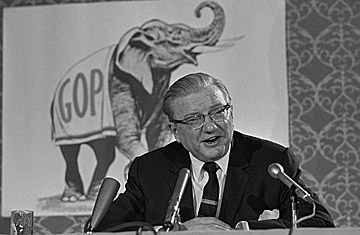
GOP National Chairman Ray Bliss
(8 of 10)
The party certainly did that. Rockefeller cut the 1962 Democratic margin in New York from 203,000 to 65,000, carried three of the city's five boroughs. In Boston, Volpe turned a 52,000-vote Democratic bulge four years ago into an 11,000-vote Republican lead. Romney reduced the Democrats' 1962 Detroit margin from 207,000 to a niggardly 37,000. Most sensational of all was Los Angeles, where Brown won by 111,000 in 1962's gubernatorial election and lost by 135,000 last week.
In part, the shifting urban vote is a result of the slow, steady erosion of the coalition of ethnic minorities, Negroes and intellectuals that F.D.R. forged 34 years ago. Negro militancy has siphoned off much support from urban Italians, Irish and Slavs. The war has disenchanted many intellectuals. Of greater concern to the Democrats is their fading appeal to the blue-collar vote, once their mainstay. California's Brown, who had the support of labor leaders but lost the rank-and-file vote, noted: "Workers used to ask about workmen's compensation and disability insurance. Not this time. The workers have become aristocrats, and when they become aristocrats, they become Republicans."
Puff, Puff. The Democrats were hurt further by intraparty squabbling in several states and by many of their candidates' stodginess on the stump. Both were once G.O.P. trademarks.
The G.O.P. congressional candidates (average age: 47.3) were mostly younger than their Democratic counterparts (49.6)—and they acted younger. While Soapy Williams reminisced about the New Deal in Michigan, Griffin cut rock-'n'-roll records for teenagers. In Illinois, Hubert Humphrey inadvertently underscored the generational gap between the Democratic and Republican styles in the senatorial campaign when he said, "The Senate without Paul Douglas would be like show business without Jimmy Durante"—who, at 73, now uses Old Man Time as a theme song. To the delight of Republican audiences in Wilkes-Barre and Philadelphia, outgoing Pennsylvania Governor William Scranton's wife Mary puffed plump cigars, promised to come back and finish the smoke—"regardless of how green I turn"—if they improved their 1962 vote totals. (They didn't.)
By contrast, the Democrats ran notably dull campaigns in New York, Illinois, Michigan and California, committed a few grievous gaffes along the way. None was worse than a scene in the 30-minute campaign film in which Pat Brown was shown telling a little Negro girl: "I'm running against an actor —and remember this: You know who shot Abraham Lincoln, don't you?"
RISE for Romney. The youthful G.O.P. campaigning style was echoed after the election by a new, partywide buoyancy—particularly concerning 1968. As the current front runner, Romney has abandoned his old coyness, last week expressed frank pleasure "that people are talking in those terms." Already, 20 Romney clubs are being formed in states across the nation; in Reagan's backyard, an outfit called RISE (Romney in Sixty-Eight) has begun soliciting Los Angeles businessmen for financial support. Less than 24 hours after his