

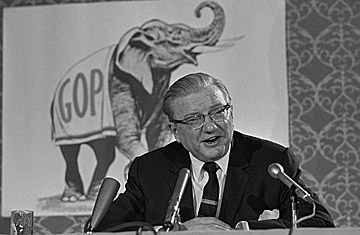
GOP National Chairman Ray Bliss
(2 of 10)
The election, said Washington's articulate Republican Governor Daniel Evans, gave the party a "very, very broad base." From this base, the G.O.P. hopes to catapult its candidate into the White House two years from now. That is quite a remarkable ambition, in view of the party's recent and desperate shortage of attractive national candidates. Suddenly, Bliss sees "a refreshing number of names," most of them belonging to moderates with immoderate ambitions. "The tremendous victories of all the potential presidential candidates confuse the 1968 picture a bit," said Nebraska's Republican National Committeeman Don Ross, adding: "It's a helluva nice way to be confused." Lyndon Johnson, who looked invincible after his record 16-million-vote margin of two years ago, now appears decidedly vulnerable.
Pulverized Prestige. Stunned by the G.O.P. showing, the Democrats reacted with initial incredulity. "I imagine it's a sort of standoff," said Democratic National Chairman John Bailey. Vice President Hubert Humphrey, his coattails shredded and his prestige pulverized by a near-total G.O.P. sweep in his home state of Minnesota, was more candid. "Misery loves company," he said, "and we've got it."
The President remained unwontedly silent for a day at his ranch, where he is resting for this week's scheduled surgery, then decided on a philosophic approach. "I would be less than frank if I didn't tell you that I am sorry we lost any Democratic seats," he said. The losses "somewhat exceeded" his expectations, he continued, and would make it "more difficult for any new legislation." But he noted, with unusual magnanimity, that perhaps it was a good thing after all "to see a healthy and competent existence of the two-party system."
While a President's impact on a midterm election is always hard to assess, Johnson could hardly absolve himself of blame for the Democrats' reverses. His performance the week before the elections was probably the least attractive of any during his three years in office. He trotted Defense Secretary Robert McNamara out to announce a pre-election draft cut that struck many a voter as a blatantly political move. He issued favorable economic figures to blunt the inflation issue (Pollster Lou Harris reported afterward that it had proved a particularly injurious factor for the Democrats nonetheless). He took a savage swipe at Nixon, thereby giving the "chronic campaigner" a boost that may find its way into the history books. And, in denying that he had been planning a last-minute blitz of twelve to 15 states, Johnson advertised his lack of veracity to millions who were even then preparing for his visit.
As it turned out, Johnson probably spared his prestige a painful blow by retreating to Texas instead of going out politicking. Save for Montana, where Senator Lee Metcalf won the only major race, Democrats suffered serious defeats in every state that the President had planned to visit. Even in Texas, Republican Senator John Tower crushed Democrat Waggoner Carr. According to a gag making the Washington rounds. "Lyndon had his