

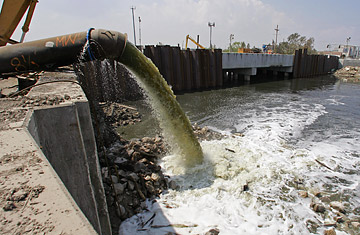
Water pumped into Lake Pontchartrain drains into the Gulf of Mexico
(7 of 9)
The effects of man-made pollution on coastal zones can often be easily seen; far less clear is the ultimate impact on open seas. The ocean has essentially two ways of coping with pollutants: it can dilute them or metabolize them. Pollutants can be dispersed over hundreds of square miles of ocean by tides, currents, wave action, huge underwater columns of swirling water called rings, or deep ocean storms caused by earthquakes and volcanoes.
Buried toxins can also be moved around by shrimp and other creatures that dig into the bottom and spread the substances through digestion and excretion. Though ocean sediment generally accumulates at a rate of about one-half inch - per thousand years, Biogeochemist John Farrington of the University of Massachusetts at Boston cites discoveries of plutonium from thermonuclear test blasts in the 1950s and 1960s located 12 in. to 20 in. deep in ocean sediment. Thus contaminants can conceivably lie undisturbed in the oceans indefinitely -- or resurface at any time.
There is little question that the oceans have an enormous ability to absorb pollutants and even regenerate once damaged waters. For example, some experts feared that the vast 1979 oil spill in the Gulf of Mexico would wipe out the area's shrimp industry. That disaster did not occur, apparently because the ocean has a greater capacity to break down hydrocarbons than scientists thought. But there may be a limit to how much damage a sector of ocean can take. Under assault by heavy concentrations of sludge, for example, the self- cleansing system can be overwhelmed. Just like decaying algae, decomposing sludge robs the water of oxygen, suffocating many forms of marine life. What effect chronic contamination from sludge and other wastes will have on the oceans' restorative powers is still unknown.
Rebuckling the planet's life belt may prove formidable. The federal Clean Water Act of 1972 overlooked runoff pollution in setting standards for water quality. Meanwhile, the nation's coasts are subject to the jurisdiction of a bewildering (and often conflicting) array of governmental bodies. One prime example of this confusion, reports TIME Houston Bureau Chief Richard Woodbury, is found in North Carolina's Albemarle-Pamlico region. There both the federal Food and Drug Administration and a state agency regulate the harvesting of shellfish. A third agency, the state's health department, surveys and samples the water and shellfish. And another state body sets the guidelines for opening or closing shellfish beds. Complains Douglas Rader of the Environmental Defense Fund: "The crazy mix of agencies hurts the prospects for good management."
Lax enforcement of existing clean-water policies is another obstacle. According to Clean Ocean Action, a New Jersey-based watchdog group, 90% of the 1,500 pipelines in the state that are allowed to discharge effluent into the sea do so in violation of regulatory codes. Municipalities flout the rules as well. Even if Massachusetts keeps to a very tight schedule on its plans to upgrade sewage treatment, Boston will not be brought into compliance with the Clean Water Act until 1999 -- 22 years after the law's deadline. Meanwhile, the half a billion gallons of sewage that pour into Boston Harbor every day receive treatment that is rudimentary at best.