

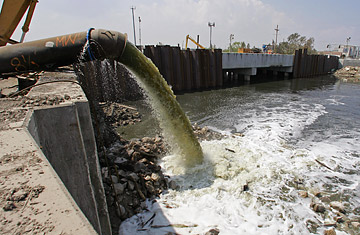
Water pumped into Lake Pontchartrain drains into the Gulf of Mexico
(6 of 9)
But the fragile estuarine systems can be overtaxed in any number of ways. Dredging can stir up the bottom, throwing pollutants back into circulation. The U.S. Navy plans to build a port in Puget Sound for the aircraft carrier U.S.S. Nimitz and twelve other ships; the project will require displacement of more than 1 million cu. yds. of sediment, with unknown ecological consequences. Similarly, natural events such as hurricanes can bestir pollutants from the sediment. The estuarine environment also changes when the balance of freshwater and salt water is disturbed. Upstream dams, for example, diminish the flow of freshwater into estuaries; so do droughts. On the other hand, rainstorms can cause an excess of freshwater runoff from the land.
Whatever the precise cause, trouble begins when the level of pollutants in the water overwhelms the capacity of estuaries to assimilate them. The overtaxed system, unable to absorb any more nutrients or contaminants, simply passes them along toward bays and open coastal areas. "When the system is working," says Maurice Lynch, a biological oceanographer at the Virginia Institute of Marine Science, "it can take a lot of assault. But when it gets out of whack, it declines rapidly."
It is then that the natural growth of sea grass may be ended, as has happened in Chesapeake Bay, or sudden blooms of algae can occur, particularly in stagnant waters. The exact reasons for these spurts of algal growth are unknown. They can be triggered, for example, by extended periods of sunny weather following heavy rains. Scientists believe algal growth is speeded up by the runoff of agricultural fertilizers. The burgeoning algae form a dense layer of vegetation that displaces other plants. As the algae die and decay, they sap enormous amounts of oxygen from the water, asphyxiating fish and other organisms.
Some kinds of algae contain toxic chemicals that are deadly to marine life. When carcasses of more than a dozen whales washed up on Cape Cod last fall, their deaths were attributed to paralytic shellfish poisoning that probably passed up the food chain through tainted mackerel consumed by the whales. Carpets of algae can turn square miles of water red, brown or yellow. Some scientists speculate that the account in Exodus 7: 20 of the Nile's indefinitely turning red may refer to a red tide.
When such blights occur in coastal areas, the result can be devastating. Last November a red tide off the coast of the Carolinas killed several thousand mullet and all but wiped out the scallop population. Reason: the responsible species, Ptychodiscus brevis, contains a poison that causes fish to bleed to death. Brown tides, unknown to Long Island waters before 1985, have occurred every summer since; they pose a constant threat to valuable shellfish beds.
A study of satellite photographs has led scientists to believe that algae can be conveyed around the world on ocean currents. The Carolinas algae, which had previously been confined to the Gulf of Mexico, apparently drifted to Atlantic shores by way of the Gulf Stream. One species that is native to Southern California is thought to have been carried to Spain in the ballast water of freighters.