

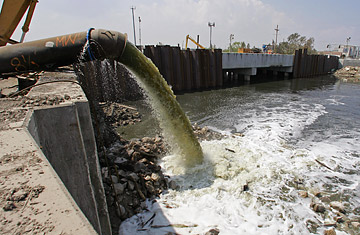
Water pumped into Lake Pontchartrain drains into the Gulf of Mexico
The very survival of the human species depends upon the maintenance of an ocean clean and alive, spreading all around the world. The ocean is our planet's life belt.
-- Marine Explorer Jacques-Yves Cousteau (1980)
After sweltering through a succession of torrid, hazy and humid days, thousands of New Yorkers sought relief early last month by heading for the area's public beaches. What many found, to their horror and dismay, was an assault on the eyes, the nose and the stomach. From northern New Jersey to Long Island, incoming tides washed up a nauseating array of waste, including plastic tampon applicators and balls of sewage 2 in. thick. Even more alarming was the drug paraphernalia and medical debris that began to litter the beaches: crack vials, needles and syringes, prescription bottles, stained bandages and containers of surgical sutures. There were also dozens of vials of blood, three of which tested positive for hepatitis-B virus and at least six positive for antibodies to the AIDS virus.
To bathers driven from the surf by the floating filth, it was as if something precious -- their beach, their ocean -- had been wantonly destroyed, like a mindless graffito defacing a Da Vinci painting. Susan Guglielmo, a New York City housewife who had taken her two toddlers to Robert Moses State Park, was practically in shock: "I was in the water when this stuff was floating around. I'm worried for my children. It's really a disgrace." Said Gabriel Liegey, a veteran lifeguard at the park: "It was scary. In the 19 years I've been a lifeguard, I've never seen stuff like this."
Since the crisis began, more than 50 miles of New York City and Long Island beaches have been declared temporarily off limits to the swimming public because of tidal pollution. Some of the beaches were reopened, but had to be closed again as more sickening debris washed in. And the threat is far from over: last week medical waste was washing up on the beaches of Rhode Island and Massachusetts. "The planet is sending us a message," says Dr. Stephen Joseph, New York City's health commissioner. "We cannot continue to pollute the oceans with impunity."
As federal and state officials tried to locate the source of the beach- defiling materials, an even more mysterious -- and perhaps more insidious -- process was under way miles off the Northeast coast. Since March 1986, about 10 million tons of wet sludge processed by New York and New Jersey municipal sewage-treatment plants has been moved in huge barges out beyond the continental shelf. There, in an area 106 nautical miles from the entrance to New York harbor, the sewage has been released underwater in great, dark clouds.
The dumping, approved by the Environmental Protection Agency, has stirred noisy protests from commercial and sport fishermen from South Carolina to Maine. Dave Krusa, a Montauk, N.Y., fisherman, regularly hauls up hake and tilefish with ugly red lesions on their bellies and fins that are rotting away. Krusa is among those who believe that contaminants from Dump Site 106 may be borne back toward shore by unpredictable ocean currents. "In the past year, we've seen a big increase of fish in this kind of shape," he says. Who will eat them? New Yorkers, says a Montauk dockmaster. "They're going to get their garbage right back in the fish they're eating."