

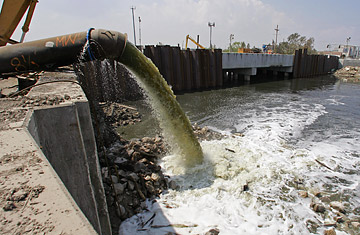
Water pumped into Lake Pontchartrain drains into the Gulf of Mexico
(3 of 9)
Suffocating and sometimes poisonous blooms of algae -- the so-called red and brown tides -- regularly blot the nation's coastal bays and gulfs, leaving behind a trail of dying fish and contaminated mollusks and crustaceans. Patches of water that have been almost totally depleted of oxygen, known as dead zones, are proliferating. As many as 1 million fluke and flounder were killed earlier this summer when they became trapped in anoxic water in New Jersey's Raritan Bay. Another huge dead zone, 300 miles long and ten miles wide, is adrift in the Gulf of Mexico.
Shellfish beds in Texas have been closed eleven times in the past 18 months because of pollution. Crab fisheries in Lavaca Bay, south of Galveston, were forced to shut down when dredging work stirred up mercury that had settled in the sediment. In neighboring Louisiana 35% of the state's oyster beds are closed because of sewage contamination. Says Oliver Houck, a professor of environmental law at Tulane: "These waters are nothing more than cocktails of highly toxic substances."
The Pacific coastal waters are generally cleaner than most, but they also contain pockets of dead -- and deadly -- water. Seattle's Elliott Bay is contaminated with a mix of copper, lead, arsenic, zinc, cadmium and polychlorinated biphenyls (PCBs), chemicals once widely used by the ( electrical-equipment industry. "The bottom of this bay is a chart of industrial history," says Thomas Hubbard, a water-quality planner for Seattle. "If you took a core sample, you could date the Depression, World War II. You could see when PCBs were first used and when they were banned and when lead was eliminated from gasoline." Commencement Bay, Tacoma's main harbor, is the nation's largest underwater area designated by the Environmental Protection Agency as a Superfund site, meaning that pollution in the bay is so hazardous that the Federal Government will supervise its cleanup.
Washington State fisheries report finding tumors in the livers of English sole, which dwell on sediment. Posted signs warn, BOTTOMFISH, CRAB AND SHELLFISH MAY BE UNSAFE TO EAT DUE TO POLLUTION. Lest anyone fail to get the message, the caution is printed in seven languages: English, Spanish, Vietnamese, Cambodian, Laotian, Chinese and Korean.
San Francisco Bay is also contaminated with copper, nickel, cadmium, mercury and other heavy metals from industrial discharges. Last year toxic discharges increased 23%. In Los Angeles urban runoff and sewage deposits have had a devastating impact on coastal ecosystems, notably in Santa Monica Bay, which gets occasional floods of partly processed wastes from a nearby sewage- treatment plant during heavy rainstorms. Off San Diego's Point Loma, a popular haunt of skin divers, the waters are so contaminated with sewage that undersea explorers run the risk of bacterial infection.
U.S. shores are also being inundated by waves of plastic debris. On the sands of the Texas Gulf Coast one day last September, volunteers collected 307 tons of litter, two-thirds of which was plastic, including 31,733 bags, 30,295 bottles and 15,631 six-pack yokes. Plastic trash is being found far out to sea. On a four-day trip from Maryland to Florida that ranged 100 miles offshore, John Hardy, an Oregon State University marine biologist, spotted "Styrofoam and other plastic on the surface, most of the whole cruise."