

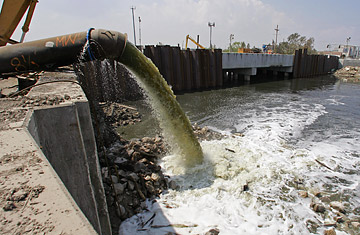
Water pumped into Lake Pontchartrain drains into the Gulf of Mexico
(2 of 9)
This summer's pollution of Northeastern beaches and coastal waters is only the latest signal that the planet's life belt, as Cousteau calls the ocean, is rapidly unbuckling. True, there are some farsighted projects here and there to repair the damage, and there was ample evidence in Atlanta last week that the Democrats hope to raise the nation's consciousness about environmental problems. The heightened interest comes not a moment too soon, since marine biologists and environmentalists are convinced that oceanic pollution is reaching epidemic proportions.
The blight is global, from the murky red tides that periodically afflict Japan's Inland Sea to the untreated sewage that befouls the fabled Mediterranean. Pollution threatens the rich, teeming life of the ocean and renders the waters off once famed beaches about as safe to bathe in as an unflushed toilet. By far the greatest, or at least the most visible, damage has been done near land, which means that the savaging of the seas vitally affects human and marine life. Polluted waters and littered beaches can take jobs from fisherfolk as well as food from consumers, recreation from vacationers and business from resorts. In dollars, pollution costs billions; the cost in the quality of life is incalculable.
In broadest terms, the problem for the U.S. stems from rampant development along the Atlantic and Pacific coasts and the Gulf of Mexico. Between 1940 and 1980, the number of Americans who live within 50 miles of a seashore increased from 42 million to 89 million -- and the total is still mounting. Coastal waters are getting perilously close to reaching their capacity to absorb civilization's wastes.
Today scientists have begun to shift the focus of research away from localized sources of pollution, like oil spills, which they now believe are manageable, short-term problems. Instead, they are concentrating on the less understood dynamics of chronic land-based pollution: the discharge of sewage and industrial waste and -- possibly an even greater menace -- the runoff from agricultural and urban areas.
Conveyed to the oceans through rivers, drainage ditches and the water table, such pollutants include fertilizers and herbicides washed from farms and lawns, motor oil from highways and parking lots, animal droppings from city streets and other untreated garbage that backs up in sewer systems and spills into the seas. Says Biologist Albert Manville of Defenders of Wildlife, a Washington-based environmental group: "We're running out of time. We cannot continue to use the oceans as a giant garbage dump."
The oceans are broadcasting an increasingly urgent SOS. Since June 1987 at least 750 dolphins have died mysteriously along the Atlantic Coast. In many that washed ashore, the snouts, flippers and tails were pocked with blisters and craters; in others, huge patches of skin had sloughed off. In the Gulf of Maine, harbor seals currently have the highest pesticide level of any U.S. mammals, on land or in water. From Portland to Morehead City, N.C., fishermen have been hauling up lobsters and crabs with gaping holes in their shells and fish with rotted fins and ulcerous lesions. Last year's oyster haul in Chesapeake Bay was the worst ever; the crop was decimated by dermo, a fungal disease, and the baffling syndrome MSX (multinucleate sphere X).