

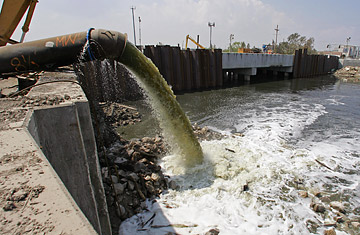
Water pumped into Lake Pontchartrain drains into the Gulf of Mexico
(5 of 9)
In the diet-and-wellness '80s, fish has been widely touted as a healthful food. Not only do smaller catches mean ever higher prices, but also the incidence of illnesses from eating contaminated fish -- including gastroenteritis, hepatitis A and cholera -- is rising around the U.S. Pesticide residues and other chemicals so taint New York marine waters that state officials have warned women of childbearing age and children under 15 against consuming more than half a pound of bluefish a week; they should never eat striped bass caught off Long Island. Says Mike Deland, New England regional administrator for the EPA: "Anyone who eats the liver from a lobster taken from an urban area is living dangerously."
Fish and shellfish that have absorbed toxins can indirectly pass contaminants to humans. Birds migrating between Central America and the Arctic Circle, for example, make a stopover in San Francisco's wetlands, where they feast on clams and mussels that contain high concentrations of cadmium, mercury and lead. Says Biologist Gregory Karras of Citizens for a Better Environment: "The birds become so polluted, there is a risk from eating ducks shot in the South Bay."
Despite the overwhelming evidence of coastal pollution, cleaning up the damage, except in a few scattered communities, has a fairly low political priority. One reason: most people assume that the vast oceans, which cover more than 70% of the world's surface, have an inexhaustible capacity to neutralize contaminants, by either absorbing them or letting them settle harmlessly to the sediment miles below the surface. "People think 'Out of sight, out of mind,' " says Richard Curry, an oceanographer at Florida's Biscayne National Park. The popular assumption that oceans will in effect heal themselves may carry some truth, but scientists warn that this is simply not known. Says Marine Scientist Herbert Windom of Georgia's Skidaway Institute of Oceanography: "We see things that we don't really understand. And we don't really have the ability yet to identify natural and unnatural phenomena." Notes Sharron Stewart of the Texas Environmental Coalition: "We know more about space than the deep ocean."
Marine scientists are only now beginning to understand the process by which coastal waters are affected by pollution. The problem, they say, may begin hundreds of miles from the ocean, where nutrients, such as nitrogen and phosphorus, as well as contaminants, enter rivers from a variety of sources. Eventually, these pollutants find their way into tidal waters. For the oceans, the first critical line of defense is that point in estuaries, wetlands and marshes where freshwater meets salt water. Marine biologists call this the zone of maximum turbidity -- literally, where the water becomes cloudy from mixing.
There, nutrients and contaminants that have dissolved in freshwater encounter the ionized salts of seawater. The resulting chemical reactions create particles that incorporate the pollutants, which then settle to the bottom. As natural sinks for contaminants, these turbidity zones protect the heart of the estuary and the ocean waters beyond.