

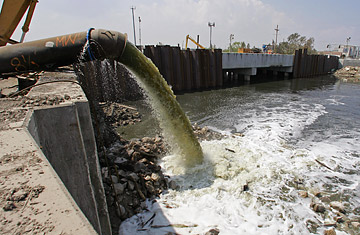
Water pumped into Lake Pontchartrain drains into the Gulf of Mexico
(4 of 9)
Nonbiodegradable plastic, merely a nuisance to sailors, can kill or maim marine life. As many as 2 million seabirds and 100,000 marine mammals die every year after eating or becoming entangled in the debris. Sea turtles choke on plastic bags they mistake for jellyfish, and sea lions are ensnared when they playfully poke their noses into plastic nets and rings. Unable to open their jaws, some sea lions simply starve to death. Brown pelicans become so enmeshed in fishing line that they can hang themselves. Says Kathy O'Hara of the Center for Environmental Education in Washington: "We have seen them dangling from tree branches in Florida."
Some foreign shores are no better off. Remote beaches on Mexico's Yucatan Peninsula are littered with plastics and tires. Fish and birds are being choked out of Guanabara Bay, the entryway to Rio de Janeiro, by sewage and industrial fallout. Japan's Inland Sea is plagued by 200 red tides annually; one last year killed more than 1 million yellowtail with a potential market value of $15 million. In the North Sea chemical pollutants are believed to have been a factor in the deaths of 1,500 harbor seals this year. Last spring the Scandinavian fish industry was hard hit when millions of salmon and sea trout were suffocated by an algae bloom that clung to their gills and formed a slimy film. Farmers towed their floating fishponds from fjord to fjord in a desperate effort to evade the deadly tide.
For five years, at 200 locations around the U.S., the National Oceanic and Atmospheric Administration has been studying mussels, oysters and bottom- dwelling fish, like flounder, that feed on the pollutant-rich sediment. These creatures, like canaries placed in a coal mine to detect toxic gases, serve as reliable indicators of the presence of some 50 contaminants. The news is not good. Coastal areas with dense populations and a long history of industrial discharge show the highest levels of pollution. Among the worst, according to Charles Ehler of NOAA: Boston Harbor, the Hudson River-Raritan estuary on the New Jersey coast, San Diego harbor and Washington's Puget Sound.
Last week the EPA added six major estuaries to the half a dozen already on the list of ecologically sensitive coastal areas targeted for long-term study. Estuaries, where rivers meet the sea, are the spawning grounds and nurseries for at least two-thirds of the nation's commercial fisheries, as well as what the EPA calls sources of "irreplaceable recreation and aesthetic enjoyment."
Although the poisoning of coastal waters strongly affects vacationers, homeowners and resort operators, its first (and often most vocal) victims are fishermen. Commercial fishing in the U.S. is a $3.1 billion industry, and it is increasingly threatened. Fisherman Richard Hambley of Swansboro, N.C., recalls that only a few years ago, tons of sturgeon and mullet were pulled out of the White Oak River. "Now that is nonexistent," he says. "There are no trout schools anymore. Crabs used to be like fleas. I'm lucky to get a few bushels." Ken Seigler, who works Swansboro's Queens Creek, has seen his income from clams and oysters drop 50% in seven years; this year he was forced to apply for food stamps. New Jersey Fisherman Ed Maliszewski has used his small boat for only two weeks this year. He is trying to bail out, and so are others.