

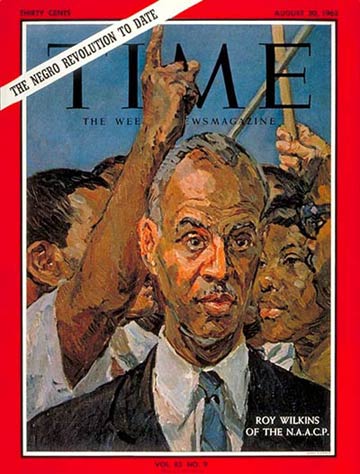
Roy Wilkins
(8 of 10)
∙HOUSING. Housing is the most emotional issue. By one means or another, Negroes are generally prevented from moving into desirable white neighborhoods. Around Chicago, only 22 of 253 suburbs have more than 100 Negro residents. In California, less than 2% of the homes built since World War II have been available to Negroes. President Kennedy's long-delayed executive order barring discrimination in the sale of Government-financed residences so far seems to have had no large-scale effect. Despite statistics to the contrary, the belief that property values inevitably fall when Negroes move into a neighborhood scares many whites who otherwise champion civil rights. In their own minds, at least, the choice is between their idealism and their wallet—and in the showdown, idealism often loses out.
∙VOTING. Despite persistent pressure by the Justice Department and courageous registration drives by Negro organizers in the South, only 29% of the region's potential of 2,000,000 Negro voters have so far been accepted by local registrars. Many civil rights leaders believe that nothing would improve the Negro's condition faster than full voting power; yet none see any prospect that this will soon happen. Federal prosecution is tediously slow. The Kennedy Administration's 1963 civil rights bill, still bogged down in Congress, would speed up the process by automatically qualifying as literate anyone who has a sixth-grade education. Unfortunately, even this would not include a majority of Negroes in Mississippi and Alabama. What some Negroes want is federal cops in the county courthouse. "I don't see anything wrong with putting a marshal in voter-registration offices on the day that Negroes plan to register," says Mississippi N.A.A.C.P. Leader Aaron Henry. "It would encourage Negroes to register and dissuade the registrar from giving them trouble."
∙PUBLIC ACCOMMODATIONS. Almost half of about 900 civil rights demonstrations staged since last May have revolved around the right of the Negro to eat in any place that he can afford, to sleep in any hotel or motel, to play in any park, or to enjoy the facilities