

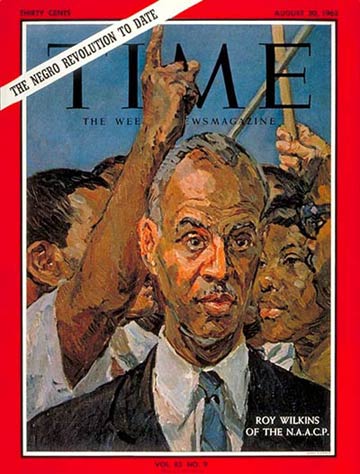
Roy Wilkins
(5 of 10)
In this epochal era of Negro frustration, new leaders and new organizations began bursting out all over. Perhaps the most successful has been the Rev. Martin Luther King's Southern Christian Leadership Conference. In 1955-56, Baptist King, an exponent of the Gandhian technique of massive but passive protest, successfully led a boycott to end bus segregation in Montgomery, Ala. The post-Little Rock disappointments gave King's movement even greater impetus. King himself has explained: "We were confronted with blasted hopes, and the dark shadow of a deep disappointment settled upon us. So we had no alternative except that of preparing for direct action, whereby we would present our very bodies as a means of laying our case before the conscience of the local and national community."
The Fangs. Last April, King sent out marchers, including troops of Negro schoolchildren, to protest discrimination in hiring and at lunch counters, rest rooms and other public facilities in Birmingham. Many civil rights leaders, both Negro and white, thought the effort was singularly ill-timed—after all, a new, perhaps more moderate, city administration was about to take over Birmingham. But the way it turned out, King's demonstrations may reasonably be considered the sparking point for the Negro revolution of 1963.
King's accomplishment came only with the inadvertent help of Birmingham whites, particularly that of Public Safety Commissioner Eugene ("Bull") Connor, who during the Birmingham crisis became an international symbol of blind, cruel Southern racism. When King sent out his marchers, Connor had them mowed down by streams from fire hoses. Shocking news photos splashed across the pages of the world's press—of a young Negro sent sprawling by a jet of water, of a Negro woman pinioned to the sidewalk with a cop's knee at her throat, of police dogs lunging at fleeing Negroes.
With that, millions of people—North and South, black and white—felt the fangs of segregation and, at least in spirit, joined the protest movement. The revolution was on—in earnest. Places little known for anything else became bywords for racial conflict—Anniston, Ala., Albany, Ga., Prince Edward County, Va., Cambridge, Md., Englewood, N.J., Greenwood and Greenville, Miss., Goldsboro and Greensboro, N.C.
Baltimore Postman William Moore, a white man murdered as he walked along an Alabama highway wearing an integration sign, and Mississippi N.A.A.C.P. Leader Medgar Evers, shot in the back outside his home, became martyrs to the cause. Direct-action protests proliferated. There were more "freedom walks" and "freedom marches"—and then came the "freedom calls," in which Negroes harass white city officials by calling them on the telephone, murmuring "Freedom" and hanging up.
There are boycotts—Negro leaders prefer to call them "selective patronage movements"—against business firms that discriminate against Negroes in their personnel practices. There are rent strikes against slumlords who refuse to repair Negro tenements. There is the "sit-in" technique and its myriad variations: the "swim-in" to integrate pools, the "wade-in" at beaches, the "pray-in" at churches, the "wait-in"