

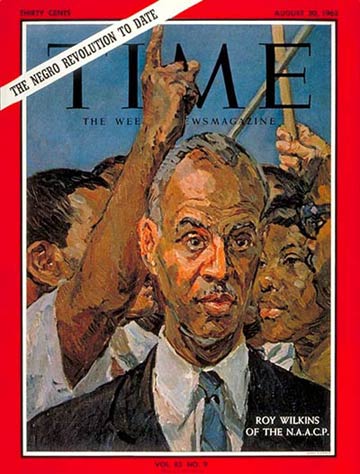
Roy Wilkins
(2 of 10)
Toward Jim Crow. Negroes helped blaze trails in America, sometimes as slaves but often as scouts and valued aides to many of the famed explorers. They were with Columbus, Balboa, Ponce de León, Cortes, Pizarro, Menéndez, De Soto. Free Negroes were among the first pioneers to settle in the Mississippi Valley in the 17th century. In Virginia, Negro colonists knew no inferiority of status, owned land, voted, mingled with whites. Some 5,000 Negroes fought the British as troops in George Washington's army.
Many of the first slaves in America were, in fact, Indians. In bondage, however, the Indian proved sickly, often died. Indentured white servants were used for a time but too often broke away, easily lost their slave identity among white colonists. Only after such failures did the white man begin large-scale enslavement of the Negro, who possessed two ideal qualities: he was strong, and if he fled, his face stood out in a crowd.
Contrary to the notion that his revolution is of relatively recent origin, the Negro has always fought against his servitude. Before the Civil War ended, there were at least 250 slave revolts or conspiracies in the U.S., including the slaughter of 60 Virginia whites in 1831. Between 1810 and 1860, some 100,000 slaves, valued at more than $30 million, slipped away to freedom in the North. Others protested in more subtle ways. They took to their beds with mysterious "miseries." They "accidentally" ruined plows and wagons. They "forgot" to cinch a saddle tightly—and many a master took a painful fall.
The Civil War brought the Negro his "emancipation," and Reconstruction gave him an intoxicating power in Southern state legislatures that he was totally unprepared to exercise responsibly (Negroes outnumbered whites in the South Carolina legislature in 1868). Easily led by the Northern white carpetbagger, the Negro lawmakers, like those in some young African nations today, indulged in an orgy of pork-barreling and political corruption. It was in direct reaction to such abuses that Southern whites, on regaining political control, enacted Jim Crow laws. The first, passed by the Tennessee legislature in 1881, imposed segregated seating in railroad cars. Other Southern states followed in other, more oppressive ways. By 1910, most of the laws that Negroes are fighting today were on the books.
Two Rows for a Bad One. It was the first decade of the 20th century that gave birth to the National Association for the Advancement of Colored People. In 1905, the brilliant but eccentric Dr. William E. B. Du Bois,* one of the founders of the American Negro Academy, set up a narrowly based protest group of Negro elite known as the Niagara Movement (its first meeting was held near Niagara Falls in 1905). Declared Du Bois: "We claim for ourselves every right that belongs to a freeborn American—political, civil and social—and until we get these rights, we will never cease to protest and assail the ears of America with the