

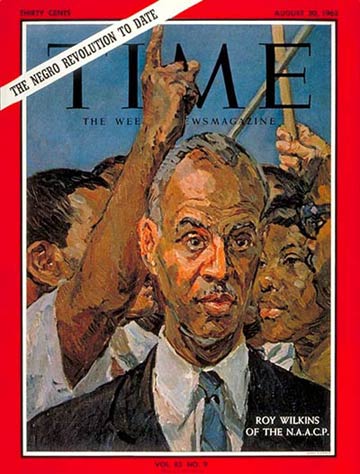
Roy Wilkins
(7 of 10)
∙JOBS. Many whites seem to assume that U.S. Negroes are better off financially today than ever before, but although Negroes made substantial income gains during World War II, they were not permanent. In the past decade, the median family income for nonwhites (now $3,191) has slipped from 57% of white family income to 53%. The nonwhite unemployment rate is now 10.7%, almost double that of whites. In such a situation, the Negro has had little incentive for self-improvement. Says Wilkins: "Until recently, Negro children didn't think about being an engineer or a scientist. So they didn't study calculus, algebra, physics or electricity. And then people turn around and say, 'Why don't those Negro kids study hard like everybody else?' You wouldn't think a plumber's job was much, but it is. A plumber doesn't work too hard or too long, but he gets paid big. And Negroes who have that skill would like to get that pay." But Negroes cannot even become plumbers—if only because of the arrant discrimination of many of the nation's craft unions. In recent weeks, one of the more dramatic signs of the Negro revolution has been in demonstrations around construction sites in Philadelphia, New York, Newark, Chicago and Elizabeth, N.J. Some Negro leaders argue that Negroes should be given a "quota" of at least 25% of the workers on any construction job. Among the many who think this is wrong is Wilkins. "We're against quotas," he says. "Our association does not believe a white person should be discharged to make room for a Negro." Another is President Kennedy, who said last week at his press conference: "I don't think quotas are a good idea. We are too mixed, this society of ours, to begin to divide ourselves on the basis of race or color." But the fact remains that the U.S. Negro wants, and has a right to, better job opportunities.
∙EDUCATION. The most dramatic clashes in the civil rights struggle have occurred over the integration of public schools. Yet last spring in 17 Southern and border states and the District of Columbia, only 7.9% of all Negro pupils attended public schools with whites. The snail's pace is indicated by the fact that this was an increase of only one-tenth of 1 % over the preceding autumn. Alabama, Mississippi and South Carolina still did not have a single Negro child seated in a subcollege public classroom with a white pupil. Georgia had only 44, Louisiana 107, Arkansas—despite Little Rock—only 247. For the upcoming school year, more than 80 Southern school districts have announced plans to desegregate. These include