

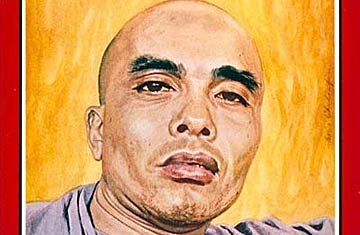
Thich Tri Quang
(6 of 9)
In Hué, all during the Diem years, Tri Quang was building up a Buddhist movement modeled after the Communist organizations that he had seen Ho employ against the French. To combat Diem's police, he organized special teams of young monks with flit guns filled with vinegar and red pepper. He had spies tucked neatly inside every fold of the Diem administration. He penetrated the regime's elite Cong Hoa youth, often got possession of top secret documents within 24 hours after they had been issued. One such paper was by Diem's brother, Ngo Dinh Nhu: Communiqué No. 3 on how to deal with the Buddhists. Later Nhu was to describe Tri Quang bitterly as "almost the perfect conspirator. In the future, his name will be synonymous with conspiracy. It deserves to be."
No Can Lao. Tri Quang's conspiracy against Diem finally flowered in blood in the spring of 1963. When the government refused to let the Buddhists in Hué fly the Buddhist flag on Gautama's birthday, Tri Quang led a demonstration to the radio station. He delivered a spellbinding speech, the crowds surged toward the station and Diem's troops replied with grenades—giving Tri Quang both the martyrs and momentum he needed. Soon Buddhists were immolating themselves on street corners, the protesting crowds grew in number and violence, and on Nov. 1, Diem and Nhu were overthrown and shot in the rear of an army truck. Ironically enough, Tri Quang sat out the last two months of Diem's tragedy in the U.S. embassy, where he had been given sanctuary from the presidential police. The Buddhists, reported the late Marguerite Higgins when she interviewed Tri Quang during that long, hot summer, wanted "Diem's head wrapped in an American flag." In one sense, they got it.
There followed a dizzying succession of governments, eroding the war effort and sapping Vietnamese credibility about any regime in Saigon. General Duong Van Minh took over after Diem, to last just three months. Then came General Nguyen Khanh, who gave way to Harvard-trained Economist Nguyen Xuan Oanh ("Jack Owen") seven months later. Oanh had six days in office before Khanh bounced back in through the revolving door. Khanh gave way again, to Saigon Mayor Tran Van Huong, then whipped back in for a third-time rule of one month. Dr. Phan Huy Quat and his "Medicine Cabinet" had a final, halfhearted try at civilian rule before asking Ky and the generals to take over ten months ago.
In all the changes, the Buddhist-controlled government that the monks felt they had earned in ousting Diem eluded the grasp of the pagodas. Tri Quang in particular felt robbed of his right to rule. He set to work systematically destroying Saigon's control in central Viet Nam by organizing a witch hunt against former members of Diem's semisecret Can Lao, which nearly all civil servants and government officials had been obliged to join. Tri Quang's committees of national salvation, created for the purpose, mobbed suspected Can Laos and chased them from office. Then he and I Corps Commander Thi together replaced them, packing the provincial administrations in I Corps with men loyal to them.