

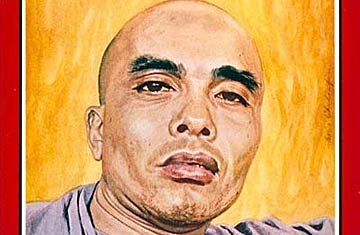
Thich Tri Quang
(3 of 9)
Then, abruptly, Tri Quang called the mobs off and early last week summoned the press to the ramshackle five-acre compound of buildings that comprises the Vien Hoa Dao. While his spokesmen read a statement threatening "a civil war that will take tens of thousands of lives because of the short sightedness, irascibility and irresponsibility of the present government," Thich Tri Quang, hardly a bead of perspiration blotting his unfurrowed brow in the 105° heat, silently looked on.
Faced with this threat, Ky and the generals then invited nearly 200 representatives scattered across the Vietnamese political spectrum to a national political congress in Saigon. Its purpose: to discuss means by which a democratic process could be organized. Ky also hoped that the delegates would provide a counterweight to the Buddhists, a hope that seemed considerably encouraged when the Buddhists boycotted the meeting and only 117 delegates showed up. But to hedge his bet and avoid further violence in the streets, Ky also quietly began negotiating directly with the Buddhist leaders.
What emerged was a typically Vietnamese solution: complex, murky and bafflingly illogical. Ky and the Buddhists reached a secret accord in which the Directory bowed to the bonzes' demands. Then, to everyone's surprise, the supposedly anti-Buddhist congress adopted as its own program the Buddhist demands that Ky had already accepted in private. Thus, Chief of State Nguyen Van Thieu and Ky appeared before the congress to decree themselves, in effect, a caretaker government. Clearly not happy about it, Ky warned that "I will fight any government that will not secure the people's happiness and fight Communism."
To keep the pressure on Ky and the congress, Tri Quang had scheduled for that night a protest march of "many, many men," and all Saigon was braced for the worst. With their point won, the Buddhists instead sent word out from Vien Hoa Dao to cool it. In an astonishing display of their power to turn the masses off and on at will, the demonstration was transformed into a peaceful, highly organized march. The 15,000 faithful that assembled at the institute left behind their plastic-bag gas masks and clubs and grenades. As they marched out to demonstrate, burly Boy Scouts ranged themselves abreast as a vanguard, staves held waist high, to keep the crowd in line. In two short hours, the promenade was over, as smoothly orchestrated in its tranquillity as the previous week's mobs had been in their mayhem.