

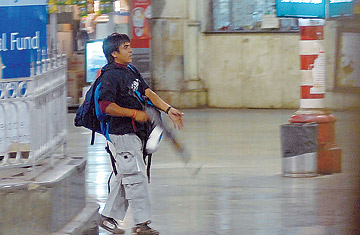
Chhatrapati Shivaji Terminus was the scene of carnage last November after Mohammad Amir Ajmal Qasab, with his partner Ismail Khan, opened fire on commuters.
(8 of 10)
Qasab and the team turned on their GPS devices at 6:54 a.m., establishing a spot near Koti Bandar, about 93 miles (150 km) southeast of Karachi, as their starting point. Al-Husseini encountered an Indian fishing trawler, the M.V. Kuber. Qasab's confession states that "once they reached Indian waters, the crew hijacked an Indian fishing vessel." But the Indian dossier and intelligence sources describe the scenario slightly differently: the sources suspect that the operator of the ship, Amar Singh Solanki, might have been lured into Pakistani waters with the promise of money for smuggling.
Solanki was asked to take a more dangerous cargo than contraband. His four employees were moved onto Al-Husseini, where there were seven other LeT members already on board, the Indian dossier states. The four crew members were later killed. Solanki took on the 10 passengers carrying huge backpacks full of weapons and dried fruit and then navigated the boat about 550 nautical miles (1,020 km) to Mumbai, until the trawler stopped at a point just 4 nautical miles (7.5 km) from the city.
When night fell, Khan, the leader of the group and Qasab's partner, placed a call to his handler in Pakistan, the dossier from India states. Khan was directed to kill Solanki. Qasab and the rest of the group abandoned the Kuber and boarded an inflatable dinghy with an outboard motor. It took them only an hour to reach shore, and the murdered captain's body was discovered much later, after the attacks had begun.
Killing the Commuters
When Qasab landed, he found himself in a place not so very different from his home village of Faridkot. The jetty at Budhwar Park, where the dinghy pulled in, is the domain of fishermen who struggle to make a living. A few challenged Qasab and his partners when they landed, but the rest were busy watching a cricket match. The strangers strode past them to the main road, and Qasab and Khan hailed a taxi, reaching VT, Mumbai's main railway station, at about 9:20 p.m.
Qasab does not explain why VT was chosen as his first target, but it looks like the kind of grand, imposing building that represents the power and vitality of Mumbai. More than 3.5 million people pass through the station every day. But the 58 people who were killed in the attack on VT, which injured an additional 104, were a world away from the wealthy élite at the Taj and Oberoi hotels or the foreign visitors killed at the Leopold Café and the Nariman House Jewish center. They were office clerks commuting back to the suburbs and migrant laborers waiting for trains to their villages. Those who died included Chandulal Thandel, a bookseller closing his stall in the station for the night, and a police inspector, Shashank Shinde, who came by almost every day to buy a magazine from him.
Qasab seems to have thought little about who his victims would be; there was no singling out of foreigners as at the Taj and Oberoi. "We went inside the railway station threatening the commuters and randomly firing at them," he says in his statement. Qasab and Khan left after less than an hour, using the footbridge made famous by Slumdog Millionaire--the perch from which, in the film, Jamal looks for Latika. Qasab's only instructions were to find a building with a rooftop where they could take hostages and attract the media. They headed west out of the station, and nearby, Qasab spotted their next target, a pink seven-story building.