

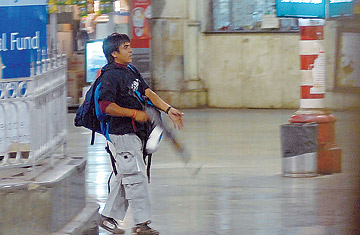
Chhatrapati Shivaji Terminus was the scene of carnage last November after Mohammad Amir Ajmal Qasab, with his partner Ismail Khan, opened fire on commuters.
(6 of 10)
The organizers at Muridke, however, had different plans for Qasab. After his initial training in the philosophy of jihad, he was sent to Pakistan-controlled Kashmir, where he finally got the opportunity to handle a gun. "We were taken in a vehicle to a place called Mansera, [where] we were given training of all weapons for 21 days," Qasab says in his confession. In the subsequent four months of training, Qasab learned to fire AK-47s, studied the Indian security agencies and was trained in the "handling of hand grenade, rocket launchers and mortars, Uzi gun, pistol [and] revolver." Other LeT militants have noted the physical demands that accompanied the firearms practice. "The training was really tough," Mohammad Usman, a former jihadi, tells TIME. "But when we went to Kashmir, on my first operation across the Line of Control [which divides Pakistani-controlled Kashmir from the Indian side], I got separated from my group for 15 days. I had nothing, so the training helped."
Usman, now 36, was one of the founding militants in LeT--and his tale, too, sheds light on the growth of jihadi militancy. As a boy in the Punjabi city of Faisalabad, he often heard accounts of Indian atrocities against Muslims in Kashmir. In the early '90s, Kashmiris toured Pakistan, telling their stories and seeking donations for their cause. Usman was moved by the story of a man whose brother had been killed by Indian soldiers and whose sister had been sexually assaulted. "Then he asked, 'If this was your sister, what would you do?' That's when I decided to join the jihad."
In the beginning, Usman joined a Kashmiri militant outfit, but soon he banded together with other Pakistanis, including Saeed, to form LeT. "The Kashmiris appreciated us because we were good fighters," says Usman. "Unlike the Kashmiris, who only did hit-and-run attacks, we stayed and fought for hours." That confidence, he says, came from the training. "We were fearless. The Koran tells us that if we are martyred, we are successful. It is the misfortune of my life that I was not martyred."
The conviction that death in jihad would lead to paradise prompted LeT to develop its most devastating tactic in the fight against India: the fedayeen, or suicide squads. Instead of simply blowing themselves up, they conducted daring commando raids, trying to do as much damage as possible before their eventual martyrdom. In advance of each operation, the teams, with from two to 10 members, joined to pray. "We told each other, 'We will meet you again in the hereafter,'" says Usman.
While Qasab never mentions that he was part of such a unit, his preparation suggests that he had been chosen to learn fedayeen tactics, which are increasingly common outside Kashmir. For his final round of advanced training, Qasab moved to another camp near Muzaffarabad, also in Pakistan-controlled Kashmir, where he says he met a man named Zaki-ur-Rehman "Chacha" (Uncle), who selected him as one of a team of 16 destined for a confidential operation. Qasab may have been referring to Zaki-ur-Rehman Lakhvi, a top LeT commander who was arrested by Pakistani security forces on Dec. 7 at a LeT compound just outside Muzaffarabad.
Missed Signals