

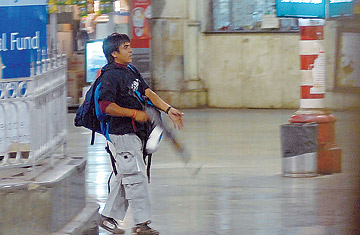
Chhatrapati Shivaji Terminus was the scene of carnage last November after Mohammad Amir Ajmal Qasab, with his partner Ismail Khan, opened fire on commuters.
(5 of 10)
In his confession, Qasab describes a strict regimen of physical training, prayers and religious lectures at Muridke. Former LeT militants who have passed through the center say it was never a training camp in the traditional sense. While would-be militants learned to swim and fight there, advanced weapons training was left for the camps in the Pakistani-controlled section of Kashmir. Only a handful of students were sent out on actual combat missions. Instead, most focused on religious doctrine. Parents in the local village who send their children to the Markaz for school say the education is good, though ideological. Ghulam Qadir, 44, has two children there, even though he follows the more liberal Barelvi tradition. School rules insist that even the primary students pray five times a day and fast during Ramadan. They are not allowed to watch TV or movies or listen to music. "I am hoping my children are not being converted, but I want them to have a better future," he says, explaining that the school is free and gives the students lunch.
The growth of Wahhabi institutions in traditionally Barelvi parts of Pakistan is not limited to Muridke. Punjab province has seen an explosion of radical mosques, madrasahs and schools, many around the southern cities of Bahawalpur and Multan. A resident of Bahawalpur describes a visible expansion of jihadi infrastructure, unchecked by government supervision. Camps modeled on the one at Muridke are being built in the city, and photographs of the construction sites show young men with AK-47 logos on their shirts. Graffiti on village walls in the region declare, "Jihad against unbelievers is mandatory. Break their necks and shake every bone."
Rana, the expert on militancy, has seen an accompanying rise in extremist activity. He estimates that 60% of all terrorist attacks in Pakistan since 2002 have originated in the Punjab. "What the militant groups are doing now," says political analyst and academic Ayesha Siddiqa, "is recruiting people and sending them to fight elsewhere." Some are going to Kashmir, she says, but many more are fighting in Bajaur and Swat, in the North-West Frontier Province, where government forces are waging a losing war to contain militancy. Groups like LeT have always been open about their goals for an Islamic state, and few doubt that they would resort to violence to achieve it. Says Siddiqa: "At a later stage, they will bring the jihad home." It may already be happening. In the provincial capital of Lahore on March 3, a dozen gunmen attacked a convoy of Sri Lankan cricketers on their way to a match. Six policemen and a bus driver were killed and several more wounded. No group has taken responsibility, but the similarities to the orchestrated assaults in Mumbai were alarming.
Killing for Paradise