

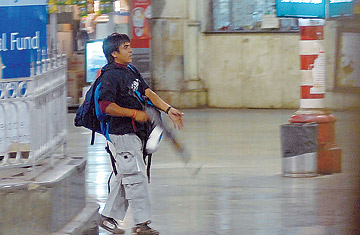
Chhatrapati Shivaji Terminus was the scene of carnage last November after Mohammad Amir Ajmal Qasab, with his partner Ismail Khan, opened fire on commuters.
(7 of 10)
Of the 16 selected for the operation, says Qasab, three ran away. The rest returned to Muridke, where for one month they were given swimming lessons and "acquainted with the environment experienced by a fisherman on a sea." (The fishpond on the Muridke campus, the size and shape of two Olympic-size pools placed at a right angle to each other, doubles as a swimming pool, a student told TIME.) While he was in Muridke, Qasab and his teammates attended lectures on the Indian intelligence agencies and watched videos highlighting atrocities committed against Muslims in India. Six of the 13 were dispatched to Kashmir; then three new members were brought into the group, according to the dossier on the attacks submitted by India to Pakistan, a copy of which was obtained by TIME. Now winnowed down to 10, the group was divided into two-person teams, and on Sept. 15 they were told their target: Mumbai.
The Mumbai attack was nominally conducted for the Kashmir struggle, but India has avoided linking the Mumbai attacks to Kashmir, and Qasab's confession does not mention it. Political leaders in Kashmir have deplored the barbarity of the attacks while acknowledging that Mumbai has drawn attention to their cause. For Qasab, the political implications of his mission were probably far from his mind as he went through the final stages of preparation. The commandos were shown images of Mumbai on Google Earth and told how to disembark from their boats. Qasab and his partner, Khan, were shown video footage of their designated target: Chhatrapati Shivaji Terminus, or Victoria Terminus, known in Mumbai as VT. The instructions were simple: "Carry out the firing at rush hours in the morning between 7 to 11 hours and between 7 to 11 hours in the evening. Then kidnap some persons, take them to the roof of some nearby building ... We were then to contact the media [and] make demands for releasing the hostages."
Qasab's final weeks of preparation were spent in a house near Karachi. It is possible that the attack had been compromised. In late September, India's Intelligence Bureau warned specifically about the Taj Mahal Palace & Tower hotel, and in mid-October, U.S. intelligence agencies warned that Mumbai was a target of an attack by sea. The hotel tightened its security and received extra protection from the Mumbai police. But nothing happened, and the security measures were relaxed in mid-November.
Qasab's group stole out of Karachi's harbor at 4:15 a.m. on Nov. 22. While port authorities say no one can leave the shore without permission, it would have been easy for the men to leave in a boat already registered with the harbormaster. There are at least 150 launches a day at the Karachi port, says Abbas Ali, who runs a launch business. "Once mariners reach the deep sea, they can do anything, smuggling, drugs, whatever. There are not enough people to check all the boats." From the launch, the team boarded another boat and then a ship named Al-Husseini, which is thought by Pakistani investigators to be registered in the name of an Islamist group associated with LeT. Each militant was given a sack containing "eight grenades, one AK-47 rifle, 200 cartridges, two magazines and one cell phone for communication."