

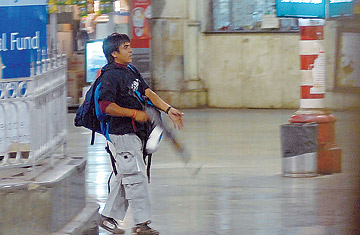
Chhatrapati Shivaji Terminus was the scene of carnage last November after Mohammad Amir Ajmal Qasab, with his partner Ismail Khan, opened fire on commuters.
(10 of 10)
Being beaten senseless by the police was not the exit Qasab had trained for. Instead of standing out from the thousands of other young men from villages like Faridkot, he was treated like a common criminal. The standoff between India and Pakistan, meanwhile, has escalated beyond him. The Indian government's dossier of evidence builds on Qasab's statement with details of the GPS coordinates and satellite-phone data retrieved from the scene of the attacks. But it does so not to strengthen the Mumbai Crime Branch's case against Qasab but to prove to the world that it was Pakistan and LeT that created him. "The evidence gathered so far unmistakably points to the territory of Pakistan as a source of the terrorist attacks in Mumbai," the dossier concludes. The ordinary things that Qasab and the others left behind on the boat--a matchbox, detergent powder, Touchme shaving cream and a bottle of Mountain Dew--are all included as exhibits, their MADE IN PAKISTAN labels presented as damning evidence.
So, too, is Qasab's story. He may have been no more than a small player. But in the places he came from and passed through and the sights, sounds and messages that he experienced, he is part of a much bigger tale, a violent drama that has rumbled over much of the subcontinent. The role has done him no good. Qasab may have escaped Faridkot and Rawalpindi. But he's no closer to the other side of the fence than when he started.