

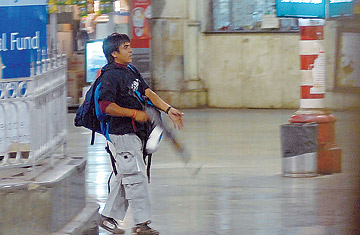
Chhatrapati Shivaji Terminus was the scene of carnage last November after Mohammad Amir Ajmal Qasab, with his partner Ismail Khan, opened fire on commuters.
(2 of 10)
But after Sept. 11, 2001, everything changed. Pakistan, given no choice by the U.S., stopped supporting the Taliban regime in Afghanistan, which had allowed jihadi training camps to flourish on its soil. On Dec. 13, 2001, a band of Pakistan-based fighters attacked the Indian Parliament. Two weeks later, the U.S. government placed LeT, one of the jihadi groups thought to be behind the attack, on its list of proscribed organizations. The next month, Pakistan's then President, General Pervez Musharraf, bowed to international pressure and declared that no Pakistan-based group would be allowed to commit terrorism in the name of religion. Musharraf banned five jihadi groups that his army had long nurtured.
To Musharraf's interlocutors in Washington, this must have sounded like progress. But his decision just shunted the jihadist mentality underground. With a nod and a wink, organizations like LeT re-emerged under new names. The camps were officially closed, but training shifted to hideaways deep in the mountains, where government officials could ignore them. Recruitment continued, strengthened by the perception of unjust--and U.S.-driven--persecution of Muslims.
It was in this climate of official duplicity that Qasab arrived in Rawalpindi. He was not seeking his shortcut to heaven. Rather, he says in his confession, he followed a friend in search of riches. "As we were not getting enough money, we decided to carry out robbery," he says, and they scoped out a house.
That was a common choice. "Robbing houses is easier than finding a job in 'Pindi," says Imran Asghar, a crime reporter for the English-language Daily Times. But to rob a house, Qasab needed weapons. So on Dec. 19, 2007, an important Muslim holiday, he set out for Raja Bazaar, a congested boulevard crammed with gun shops and decorated with hand-painted billboards portraying men hoisting AK-47s. Seeking guns in Raja Bazaar was an amateur move (even in 'Pindi, without a license, you won't get a gun from a shop), but it led Qasab to a LeT stall that had been set up for the holiday. "We thought that even if we procured firearms, we could not operate them," he says in the confession. "Therefore, we decided to join LeT for weapon training."
Qasab does not say in his confession if he ever robbed the house. It doesn't really matter. Crime and terrorism are intertwined--illicit weapons-trading, drugs, smuggling and kidnap-for-ransom schemes fund terrorist networks all around the world. In Pakistan, the connection is deeply ingrained. "When someone commits a crime," says Asghar, "there are so many hands to support him but so few to pull him out. And if I feel guilty for what I have done, I go to mosque. There I am invited to jihad, and I am given a license for paradise. That is where crime and terrorism meet." From the LeT stall, Qasab was directed to the group's offices, where after a brief interview, he was given the address of a training camp and money for the bus. He was on his way.
The Banality of Terror