

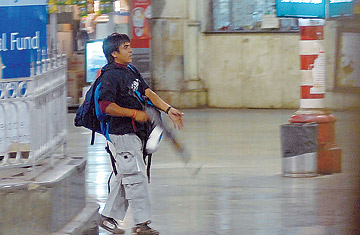
Chhatrapati Shivaji Terminus was the scene of carnage last November after Mohammad Amir Ajmal Qasab, with his partner Ismail Khan, opened fire on commuters.
(3 of 10)
It would be convenient to think of Qasab as a psychopath, exploited by cynical handlers who corrupt young men in the name of religion. In fact, his origins are ordinary. In his confession, Qasab, now 21, says he was born in the village of Faridkot, in Pakistan's Punjab province. He is said to have been a typical teenager, not especially religious, albeit with a reputation as a troublemaker. His family is poor--his father sells fried snacks at a bus station--but owns its own house. Qasab attended the local primary school; at 13, he left the village to live and work with his elder brother in Lahore.
Qasab's is the classic profile of a jihadi, according to Pakistani psychologist Sohail Abbas. In 2002, Abbas interviewed 517 men who had been jailed for going to fight U.S. troops in Afghanistan. Unlike the stereotypical image of a terrorist--illiterate, fanatic and trained in madrasahs, or religious seminaries--the men had relatively high levels of literacy and were more likely to have been educated in government schools than in madrasahs. Religion wasn't necessarily the only reason they turned to jihad. A Pakistani who enrolled in a training camp in Kunar province, Afghanistan, told TIME that he went for "tourism and adventure."
Faridkot is not the hardscrabble village conjured up by common perceptions of extremist origins. It straddles a paved road about 2 ½ hours' drive from Lahore, and two new gas stations mark the village boundaries. Beyond those are factories and fertile farmland. There is even BlackBerry service. But it is, undeniably, the sort of place that fosters frustration. Feudal landlords own the farmland, and villagers feel trapped by the status they are born into. The good life is tantalizingly close, yet for most residents still unattainable. For men like Qasab, one of the best ways out is jihad. "In a developing country, youngsters who are sensitive, concerned, they talk about 'How do we change what is going on here? How do we get rid of corruption?'" says Abbas. "And if in some sense you find that jihad can help you in those aims, then why not?" It's a convolution of the adolescent craving to stand out. And Pakistani society, steeped in nihilistic passions fostered by the state sponsorship of jihad, condones it.
District governor Ghulam Mustafa (who denies that Qasab is from Faridkot) says the area has a long history of sending men to fight in Kashmir. Despite the risks, joining a militant network provides social mobility that is virtually unattainable in Pakistani society, giving the groups' members a sense of purpose and pride and elevating their status, says Muhammad Amir Rana, a Pakistani expert on extremist groups. And indeed, villagers have told journalists that when Qasab went home to see his family just before the Mumbai attacks, he was a changed man--calm, with a sense of purpose and able to demonstrate his new fighting skills.